Wednesday, June 1, 2011

Media as carpetbaggers

Recently I had a discussion with someone from Associated Press. Apparently, he was in the Intergalactic Weather Center to do yet another piece on tornadoes. Among other things, he asked me about Mark Svenvold's book on tornado chasing, which I reviewed here. In that review, I begin with:

This book is the product of another 'carpetbagger' - someone migrating temporarily into the world of storm chasing, doing his research, putting down his thoughts on what he's seen, and then packing his bags, off onto some new topic to write about and sell yet another book.

It dawned on me during this conversation with the person from AP that essentially all of the media reporting on tornadoes and science is being done virtually exclusively by carpetbaggers. The inaccuracy and lack of substance in media reporting is a direct result of the reporter's profound ignorance about the scientific subject. The people who actually know something about the subject matter typically are not those doing the media pieces. Reporters and documentary production teams roll in to do interviews either because of some recent events that call attention to tornadoes and tornado science, or because someone decided it was time to do another piece about the topic. Whatever the motivation, it's only a happy accident when they ask a meaningful question or know enough to interview someone who actually knows something and the interviewee manages to convey something accurately and clearly in his/her allotted soundbite(s) within the piece. That tidbit of reasonable information, however, will be overwhelmed by a veritable tsunami of misinformation in other pieces, or even by other content in the same piece containing the lonely morsel of accurate, meaningful information. How can the public tell the difference? Short answer -- they mostly can't.

Carpetbaggers frequently focus their interviews on "names" in the field, some of whom may be in management and who may not actually know much about the subject. Interviewees always have personal biases in how they see things (that includes me, of course!), so the tidbit that gets quoted from them may not be representative of how many members of the profession feel about any given topic. Given that everyone is biased, how does one distill the truth from all the media pieces? Seeking the truth is about getting information from many sources, not just the "names" in the field, or what the media provide. But most people don't seem to be all that interested in tornadoes (for example) -- except possibly when it's on the evening news or when it affects them personally. For many, it's evidently too much trouble to spend time searching for the truth by doing some serious study of the topic. So they view the garbage that spews out of the media and think they learned something, when most of what they received was superficial crap, much of it actually misinformation.

The media reporters are almost unanimous in their contempt for their audience. "Dumb it down to the 3rd grade level, please!" If all the public ever gets is 3rd grade content, then this contempt becomes a self-fulfilling prophecy. No one seems interested in challenging their viewers to think, apparently because they believe they're incapable of it. That's not what the media are about, it seems.

The sad fact is that if media pieces are the primary process by which most people learn about tornadoes and tornado science (or any other technical topic), then any attempt to inform them via this pathway is doomed. There's no reason to attempt to interject your knowledge and experience into the torrent of media content, because it will end up being diluted beyond recognition. People who study and forecast tornadoes aren't writing these media pieces -- they're quite fully occupied with doing that work, which absorbs most of their attention (apart from whatever time they might devote to their families and hobbies). And the media moguls aren't very interested in seeking their contributions, anyway. What does a scientist know about journalism?

As luck would have it, I was a budding journalist in high school. And my journalism mentor made it very clear to me that if you do an interview, you have to work very hard to get your facts straight. You don't write the story until after you've done the research. And you should ask your source(s) to check your story for factual content before you run it! This standard of journalism seems to have become "old-fashioned" and mostly "out of style" today. The superficiality and outright misinformation pouring from the media on a daily basis is an inevitable result of this carpetbagging. Today's style of journalism makes this inescapable, so I don't do interviews any more!

Monday, May 30, 2011

Compensation

From time to time, my observations of the way people behave lead me to despair for humanity. It sometimes seems that god must love shitheads, because there are so many of them. Fortunately, there is the gift of friendship, which reminds me that most of the people I know aren't actually shitheads, even if I don't agree with them about everything.

In fact, when I travel about, it seems that most of the folks I encounter here and abroad are really good folks with whom I have so much in common that whatever differences might otherwise divide us pale into insignificance. I've been privileged to know some amazing people, including a few famous ones, but mostly just "ordinary" folks like me who actually are extraordinary in their capacity to contribute to the world in ways that may not be visible to everyone. I know these people and their insights inspire me, their generosity shames me, and their spirits soar to heights I can only aspire to in my dreams. To have such people in my limited sphere is such an astounding blessing, on the occasions when I take the time to think about it (like tonight), all my despair falls away.

I continue to see hope for our species, however many shitheads try to dirty the water with their disgusting bigotry, phenomenal arrogance, pathetic tribalism, and stubborn ignorance. It strikes me that a lot of what is wrong with humans is their deep-seated insecurity, which drives them to attack what they don't understand and to deny that anyone not just like them has the right to be different. If we're to endure the trials I see in our collective future, we must overcome that insecurity and try our best to work together for the common good.

I've benefited tremendously from people with whom I have really deep-seated differences of opinion about various things. How can this be? Because I long ago outgrew the need to prove my own worth to myself and so have no need to prove it to them. My wife was a major factor in this change, as were my children, so if I seem to be reasonably well-grounded, it is directly attributable to my family. From the base of being comfortable in my own skin, it's been easy to accept differences of opinion with others. I've learned much and grown as a person precisely because I don't feel threatened by someone with a different viewpoint. In fact, a civil discussion with them about topics over which we differ helps me to clarify things.

How many total strangers do we curse and abuse because of some perceived flaw in their behavior? I might not like the actions of someone who drives stupidly on the highways, but I have to admit that if I knew them, I might like them despite their bad driving habits. I shouldn't feel anger about their behavior nor should I condemn total strangers.

At least tonight, I ponder the range of people I call my friends and I realize that many of them might not get along very well. In some cases, I know that for sure. The only things this group has in common, to the best of my knowledge, is that they're my friends, and they've all brought something I value into my life. For me, that's adequate compensation for the shitheads of this world. It gives me the hope to keep trying to make positive changes.

Wednesday, May 25, 2011

Pick your favorite bogus "explanation"

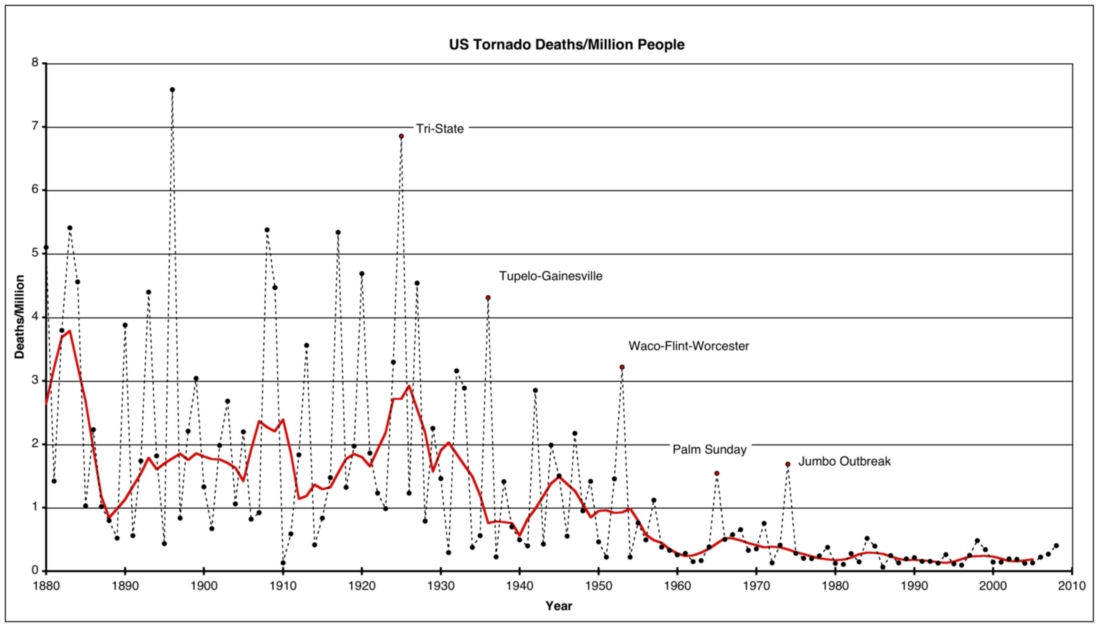
Evidently, 2011 is going to be a bad year for tornado fatalities. A really bad year. You have to go back to 1947 to find a single tornado that killed more people than were killed on 22 May in Joplin, MO. We're approaching 500 fatalities with much of the tornado season yet to come, and the last time we had more than 500 fatalities in a single year was 1953.

1953 was a terrible year, with three major single violent tornadoes: Waco, TX on 11 May (114 fatalities), Flint, MI on 08 June (116 fatalities), and Worcester, MA on 09 June (94 fatalities), as well as many lesser outbreaks. At the time, there was speculation that the severe weather was being "caused" by the nuclear explosions going on as the United States flexed its cold war muscles. The media did what the media always do: spread wild speculation about the influence of atomic tests on the weather without regard for its scientific validity. Such talk went on for years, to be raised again in 1957 (another big year for tornadoes, but without the extreme fatality count).

Almost every time there are major tornado events, the media seem compelled to ask the inevitable stupid question: what's causing this wild weather? The production crews descend on National Weather Service offices with reporters and cameras rolling, endlessly asking the same ignorant questions. The media simply can't extricate themselves from their own ignorance, being inclined to believe that there must be something to "explain" what's going on with some simple phrase if they can just get their "expert" to utter it as a sound bite. Whenever severe weather happens, it's a "freak" storm, that struck without warning, sounded like a freight train, looked like a war zone afterward, occurred with a clash of air masses, etc. The media prefer hackneyed phrases to substance, it seems.

The tornado threat varies widely from year to year. In meteorological terms, every year is different, and so it's easily understandable that some years have many tornadoes, and other years not so many. It's called "interannual variability" and for tornadoes, our understanding of that variability is troubled with many issues regarding how accurately we know the facts about the tornadoes that happen.

In 2011, the popular "exotic" media explanations for tornado outbreaks include: La Nina, global warming, global cooling (!!), god's wrath, and local terrain features that are being blamed for these "weather gone wild" events. From the perspective of someone who's spent a career looking at tornado occurrence records, one thing is abundantly clear: these events require no exotic "explanation". The past is the key to the present and future. By looking at data from the past, it becomes clear that events similar to what have been going on this year have happened before (most recently in 1953) and they will happen again (although we can't yet predict exactly when and where). Major disasters occur when violent tornadoes track through populated areas. Since most tornadoes spin out their existence over open country or thinly populated areas, we don't have major tornado disasters every year. Really big tornado outbreaks happen at intervals of roughly 20-40 years or so. The vulnerability in any given year is increasing because of our increasing population at risk (suburban "sprawl" and increasing recreational use of some areas), but it seems that this has been mostly offset by better forecasts and warnings, improved methods of communication of the threat when it develops, and infrastructure enhancements promoting natural hazard preparation (at least until the past decade or so). But those improvements have not eliminated entirely the threat for high fatality counts, as events this year have demonstrated.

When these big fatality counts occur, it's mostly a matter of bad luck. For the most part, we've had good luck for several decades, but it seems this year that our good luck has deserted us. But there's no need to resort to "exotic" explanations for every bad event. Specific reasons for individual fatalities can be difficult to figure out after the event, since those killed are unable to explain to us what happened to them. In some cases, contributing factors can be deduced or nearby survivors may be able to tell the tale, but in other cases, it's simply not possible to know what contributed to the misfortune. We're now in the situation that more than 50% of modern casualties of late (at least in lesser tornado events) have been associated with flimsy mobile homes. The poor, the handicapped, the elderly -- all are particularly vulnerable in tornado situations. People can be killed in well-constructed homes when they experience violent tornadoes that simply sweep those homes away if they have no tornado-resistant shelter (as in much of the South, where basements and tornado shelters are relatively rare).

Major events causing many deaths are typically well-warned for by the National Weather Service. Nevertheless, when strong-to-violent tornadoes pass through populated areas, people almost certainly will be killed, even when warnings are issued with more than enough lead time. The reasons for that are complex and not entirely understood, but those fatalities are almost never the result of "it struck without warning" in the sense that a warning was not issued with useful lead time. Sadly, this loss of life continues to be inevitable despite our best efforts. No special explanation is necessary, beyond the bad luck of being in a tornado's path without anywhere to go.

Sunday, May 22, 2011

A Growing Sense of Revulsion

Tonight (22 May), on the 30th anniversary of a chase day that was wild and spectacular for me and my old chaser partner (Al Moller), I read with sorrow of the devastating events of yet another tornado disaster -- this time in Joplin, Missouri. 2011 already has been a terrible year for tornadoes, the like of which hasn't been seen since 1974, and we have a lot of the heart of the tornado season yet to go. Thing likely will get worse ...

Social media have revealed to me multiple videos so far this year of non-chasers caught up in these events who clearly have no clue about tornadoes, shooting video even as they come close to death. I also see videos posted from storm chasers whooping and hollering with excited joy about the spectacular things they're seeing in their videos aired on social media (a public venue, after all) -- quite evidently unconcerned about the feelings of those for whom these very same atmospheric events have turned their lives upside down.

Many of these videos are taken not by chasing hobbyists but by people who know little or nothing about storms, perhaps choosing to keep their cameras rolling in hopes of achieving fame and fortune, or for reasons of their own. They flirt with death and often have no idea what they're doing. Why? Is it the accumulated effect of of seeing videos on TV from storm chasers dancing on the edge of the precipice? How many people have died this year with video camcorders in their hands? How many will in the future? To what extent are we chasers responsible for that?

Ironically, the Discovery Channel premiered a program tonight about the 27 April tornadoes, showing (among other things) Reed Timmer seemingly just beginning to comprehend that what he has built his fame upon has the capacity to inflict death and disaster upon people caught in the track. The very phenomenon that excites storm chasers has a very dark side -- a side I saw with my own eyes within the second year of my storm chasing career (1973) -- see item #32 here for this little piece of my chasing history. Reed (and/or the Discovery Channel) seems still to believe that his calling in tornado reports was a significant contribution to the saving of lives on 27 April. Wrong! I have serious doubts that any chaser reports made any significant difference to the outcome on 27 April. That day's tornado outbreak is not the kind of event where chaser reports are going to make much of a difference in terms of saving lives -- see here for a discussion. How much science (of the sort associated with peer-reviewed scientific journal papers) has Reed actually contributed to the problem of tornadoes? Precisely ... zip! He may have the degrees to call himself a meteorologist, but he's not yet demonstrated by his publications that he's a scientist.

The fact of the situation is that tornado disasters are virtually inevitable when powerful tornadoes pass through populated areas; 27 April included several long, track violent tornadoes in a part of the world where the human vulnerability was large. You don't need exotic, poorly-researched explanations to understand the death toll on 27 April. Some of us have expected this sort of event to happen and, unfortunately, our predictions were accurate -- although we couldn't predict which year, which month, which days would fulfill that prediction. It doesn't make me happy to be right about this. In fact, it's awful to know that such events are coming and there's nothing I seem to be able to do to prevent them from happening. People seem immune to the message of our science until a tornado has left their lives shattered.

In this year's events, I repeatedly hear people in videos saying "I've never seen anything like this before!" Well, perhaps that's true in in the limited sense of having it happen in front of your eyes, but I guarantee that almost all of these folks have seen videos of tornado disasters on TV. Did you think you were somehow immune? What people find so astonishing is that it actually happened to them!! Well, I've got some news for you, folks -- it can happen to you, and if you don't think so, you're gambling your life and the lives of your loved ones that it won't. If you do nothing to prepare, then you have only yourself to blame for the outcome. It's time to take personal responsibility for your own safety, folks!!

I find the public celebrations of storm chasers more disturbing and repulsive every year, when the outcome of these events can be so devastating to so many people. Chasing is a hobby -- it's not about contributing to society for most chasers -- for many of the "new breed" of chasers, it's about personal success, fame, and fortune. As time passes, it's increasingly abhorrent to me to be associated with most chasers, whose egocentricity and superficiality are disgusting to me. They give little or nothing of value in return for their experiences but somehow have convinced themselves that they're saving lives. Obviously, there are responsible storm chasers, but their fraction of the chase "community" seems to be decreasing as storm chasing rapidly becomes a "trash sport".

Monday, May 2, 2011

Why I'm not celebrating

I’m going to offer my thoughts about what’s been happening as a result of the announcement last night about the killing of Osama Bin Laden. My comments will not be universally popular. As the celebrations in the streets go on, Bin Laden’s well-deserved death doesn’t leave me particularly joyful or contribute in any way to my pride in being an American. My pride in being an American depends on constitutional freedoms that other people around the world envy (and even hate).

I should start off by saying that I have no sympathy for Bin Laden, nor am I sorry he's dead. He chose to live by the sword, and he died by it. Justice of the eye-for-an-eye biblical sort has been served. And I’m not a blanket opponent of the death penalty -- far from it, in fact. Osama’s actions have resulted in thousands of deaths -- perhaps tens of thousands if the final tally were to be completed comprehensively. He certainly can be said to have deserved to die. Of course, in muslim eyes, Osama Bin Laden is now a martyr to the cause of islam. This is untrue, of course. He's the now-dead leader of a terrorist group that has used the defense of islam as an excuse to serve political ends: seeking to install a world-wide muslim theocracy.

But I find the notion of my country sending out "death squads" to commit premeditated murder is not something in which I find cause for pride or celebration. This leaves us on the moral level of right-wing dictators in South America and elsewhere around the world. We're so pleased with our military right now, perhaps without realizing the "might makes right" implications of our government’s actions since 9/11/01. Note that I'm not condemning the warriors -- only the war. It's like in a movie, where if the crime is egregious enough, that justifies any response that might follow. Killing people in movies always seems to be a way to solve problems, but life is not a movie. Death only solves a small class of problems.

Moreover, this "justice" was accomplished without trial. At least the equally nasty dictator Saddam Hussein was given a trial before he was executed -- something neither Saddam nor Bin Laden ever gave their victims. In that sense, we remained on a higher moral plane than Saddam -- before we killed him. I suppose someone will argue that Osama was killed in a firefight, resisting capture. I suspect he was simply murdered but, of course, I have no way of knowing that one way or another. Who would want to give the bastard the forum for his hate that a trial would allow? But for a nation that professes to cherish law and order, summary execution seems rather inconsistent with those principles. People around the world see our actions as not being consistent with the principles we claim to cherish. Our hypocrisy reveals our lies to them, although many Americans are blind to that hypocrisy.

Another rationalization could be that this was an evil person who deserved to die. I'm reminded of the lines from the movie Lord of the Rings:
Many that live deserve death. Some that die deserve life. Can you give it to them, Frodo? Do not be too eager to deal out death in judgment. Even the very wise cannot see all ends.

There's little doubt in my mind that Osama deserved to die, perhaps many times over if that were possible. Does his death bring back the thousands of people killed as a result of his deeds? Of course not. The biblical god claims vengeance to be his, not belonging in the repertoire of humans [although the bible seemingly contradicts this principle, so choose your point of view]. Mere execution could seem to some to be letting this guy off too easy, of course. At the very least, we could've waterboarded him for a few weeks, right?

Nor can I say I'm particularly happy with our President claiming we're a nation "under god", and asking that his god bless America -- just which god is the one of whom the President speaks? Apparently, he's referring to the god of the bible. Not all of us in the USA believe in the biblical god invoked by the President. It seems the President can't be speaking on behalf of those who don't believe in his god. I guess that means he isn't speaking for me, in particular. Is not the god of the bible the same god (by a different name) claimed by islam? Can god possibly be on both sides of a war? It seems it must be so, since both sides are claiming him (which seems to happen a lot in history). In that case, what sort of god is this, playing both sides? Is this the sort of deity we choose to believe sanctions whatever we do in his name?

It seems we're willing to give up our liberties, sacrifice our youth in wars on foreign soil, and commit murder in the name of justice -- explain to me how these actions are different from the terrorists! One of the goals of the terrorists all along has been to demonstrate the moral bankruptcy of the USA. It seems they're succeeding. I've already discussed this elsewhere.

Recall how we all felt when we heard that Palestinians were celebrating in the streets after the attacks of 9/11/01? We were astonished that any people would actually be celebrating the death of innocent civilians. Osama Bin Laden was hardly an innocent civilian, but he had become a symbol of defiance for muslims around the world who feel persecuted (and they have the innocent civilian deaths to back up their claim). I can well imagine muslim youths lining up to volunteer to be suicide bombers, seeking vengeance for the death of Bin Laden. I'm sure they see our celebrations over the death of Bin Laden in the same way we saw those celebrations in Palestine. Vengeance begets vengeance, not justice. We may be pleased with ourselves for finally taking vengeance on him, but we likely won't be happy with what ensues.

People on both sides of this conflict between islam and the west have allowed themselves to be consumed by tribalism, spurred on by political "leaders" who have used religion and nationalism as tools to demonize the other side, justifying merciless jihad and vigilante "justice" in the process. The death of Osama Bin Laden will not cause terrorism to roll over and die. Our security has not been increased by this act of vengeance. The pain of our losses will not be eased by the absence of this terrible (but increasingly irrelevant) man on the Earth. I can see no cause for celebration, nor any end to the bloodshed and pain of this war on terrorism that employs terrorist tactics (murder and torture, among others) by Americans in retaliation.

Sunday, May 1, 2011

Ignorance is not bliss

The 27 April 2011 outbreak of tornadoes in the southeastern US clearly has achieved historic proportions. Its death toll has exceeded the so-call Super Outbreak of 03 April 1974. It remains to be seen what the final count of tornadoes and violent (EF4-5) tornadoes will be. It's possible that the "Super Outbreak" has been exceeded. Whatever the final tally turns out to show, it seems obvious that the 27 April 2011 event has achieved its place amidst the most infamous outbreaks in US history.

The media seem to be focused on the "freak" nature of this event, as usual. For those of us who have spent years studying the record of US tornado events, this outbreak is simply a reflection of what's possible as seen in the historical record and, in fact, what's most likely. Some of us have predicted this vulnerability. Events of the sort like 27 April 2011 occur roughly every 20 years or so -- the frequency is not at regular intervals, of course, and each event is different. But the long history of tornadoes in the US makes it clear that large fatality counts result from the infrequent coincidence of violent, long-track tornadoes with populated areas. Although outbreaks of long-track violent tornadoes in the southeastern US are relatively infrequent, the southeastern US is particularly vulnerable: a large fraction of mobile home owners, a relatively high density of communities at risk, a growing population at risk, a relatively low fraction of homes with basements, and so on -- all resulting in a high vulnerability whenever long-track, violent tornadoes occur. Thus, the tragic events of 27 April 2011 were quite predictable, although we couldn't know exactly when or where this would happen.

By studying the historical record, it's possible to anticipate events such as 27 April 2011, although we can't know precisely when they will occur. Despite advances in technology and in the infrastructure devoted to tornado warnings, when violent tornadoes interact with population centers, people will die. The infrastructure dedicated to saving lives in situations involving tornadoes has resulted in roughly a factor of 10 decrease since 1950 in average annual tornado fatalities. But the increase of population at risk has begun to offset this, in part associated with an increasing fraction of people living in mobile homes (where their risk is substantially higher than those living in "stick-built" homes). We've reached the point where the majority of tornado fatalities are those living in mobile homes, and there's a higher percentage of such in the southeastern US than elsewhere.

Thus, as I suggested in the earlier essay, the southeastern US was the most likely location for an outbreak resulting in a large number of fatalies. At times, being right is not a very satisfying situation. But it does underscore the reality that the US remains vulnerable to tornadoes, despite the new technologies and the new warning infrastructure. Even more devastating events are possible in the future. We aren't invulnerable to tornadoes and not likely to be anytime soon.

Friday, April 29, 2011

A disgraceful sham of a program

We're on the second day after a historic outbreak of tornadoes in the southeastern US, that has had tragic consequences. Anyone familiar with these events knows that clean-up begins virtually immediately after a tornado has passed. A big part of the need for clean-up is to allow search and rescue by first responders, and so debris is moved off streets and highways to allow them access.

Although these and subsequent clean-up efforts are necessary and clearly need to begin as early as possible, one consequence is that they disturb the evidence needed for a "forensic" survey team. Therefore it has been deemed important that survey teams arrive as soon as possible after the event -- preferably early in the morning on the day following the event. They need access to the damaged areas (which often are closed off to prevent looting!) in order to glean the information they need before the rubble is piled up and carted away. BTW -- I've literally written the book on the subject and have been a national Quick Response Team member since it began -- I've been on precisely one damage survey (the 4 May 2003 event in Kansas City) since the QRT began! No one has called to ask me to participate in the survey for the current event.

In the past, we had Prof. Ted Fujita to do major event surveys. He had the influence and the resources to put a large team together and get them to the scene quickly, in order to obtain the information they needed to learn from these tragic events. With his death, there was a period when no one took any responsibility for doing scientific surveys after tornado disasters. The National Weather Service (NWS) was content with the "service assessment" process. Following the tornado outbreak of 3 May 1999 and especially the La Plata, MD tornado of 28 April 2002 (which was initially and erroneously rated an F5 tornado), the NWS instituted the Quick Response Team (QRT) -- the members of this national "team" were recruited from the ranks of those with experience at doing surveys of tornadic storms. They all volunteered to serve without compensation (save for travel costs) in order that we obtain the forensic evidence necessary first to understand what happened in detail, and then to learn whatever lessons could be gleaned from that evidence. The goal was to provide the advice of experienced people for the purpose of establishing the estimated intensity of the tornadoes (i.e, their F-scale - now supplanted by the EF-scale).

For a few years, this national QRT operated more or less as intended, but then it seemed that some tender egos in the NWS began to fear that they were losing control of the process. They felt they had sufficient "in-house" expertise to carry out the investigations and didn't require the services of "outsiders" in the process. I can't pretend to know precisely what NWS managers thought, but the net result has been that the national QRT is now a pathetic sham of a program. For all intents and purposes, it simply doesn't exist. The only person ever called to do a "national QRT" now is Tim Marshall, who is unquestionably one of the best. I'll leave it to the NWS to explain why Tim is the only one upon whom they now call who isn't an NWS employee. I don't understand why the NWS is refusing the advice of experienced "experts".

But a major event like the one of 27 April 2011 demands a team of folks doing the work. There are just too many tornadoes for one person to cover. Tim can only do so much and the clock ticks relentlessly as the clean-up proceeds. The 27 April 2011 outbreak of tornadoes in the southeastern US needs to be investigated using all available resources including the national QRT, and yet it seems the national QRT is on hold because the national Warning Coordination Meteorologist was out of the office yesterday!! And there are problems in coming up with the funding to support any travel by the team. Issues regarding travel support for the team should have been resolved years ago! This amounts to a disgraceful episode for NWS management. An important way to compensate our society for the damage and pain caused by tornadoes is for us to do our jobs and learn as much as we can from them. The moribund state of the national QRT is clear evidence of an inept performance and a lack of commitment by NWS management that is inhibiting the accurate assessement and comprehensive investigation of this tragic and historic tornado outbreak.

Wednesday, April 27, 2011

A dangerous illusion of safety

Yesterday marked the 20th anniversary of an infamous tornado outbreak. I'm not going to discuss the event itself here, but want to focus on the continuing problem that the news coverage of the storm produced. In that video two reporters from Wichita TV station KSNW (cameraman Ted Lewis and reporter Gregg Jarrett) are shown, first attempting to run from the tornado and then taking shelter under an overpass on the Kansas Turnpike (Interstate-35) near El Dorado, KS, and helping passerby Butch Gilbert and his children up between the overpass girders. They all emerge unscathed after the tornado passes, but clearly are frightened by their experience.

There are many issues with this video that can be debated, but the main point I want to make here is that 20 years later, we're still dealing with the problem the video created: people seeking shelter from severe weather under highway overpasses. An extended presentation about why using overpasses for tornado shelters is a bad idea has been developed in an effort to counteract the impression that highway overpasses are viable shelter options.

Some friends of mine and I made the prediction soon after we saw this video that people would die taking shelter under overpasses. That prediction, sadly, came to pass on 3 May 1999, when three people were killed (and many others sustained major injuries) while seeking shelter under overpasses in Oklahoma. It's my opinion that the airing of that video is clearly and directly responsible for those fatalities. Those fatalities (and others, likely to come) are the unintended consequences of journalists doing their jobs.

What concerns me most here is the enduring impression created by the many, many airings of that dramatic video. The very evident message of this video, whatever reasons may have motivated its creation and presentation, is the erroneous notion that taking shelter under an overpass provides safety from tornadoes. My NWS colleagues tell me they've learned that some people are leaving their homes to take shelter under overpasses! It seems that no matter how many times people say this is absolutely not the correct thing to do, the impact of that video overwhelms those spoken (or written) words -- it's the old saying about a picture is worth a thousand words. In this case, a video is apparently worth tens of thousands of words. The video lives on via YouTube, of course.

Of course, someone might say, "Well, those folks sheltering under the overpass survived! What's the problem?" It's likely the reporter and his cameraman were ignorant of the fact that they could easily have outrun the tornado and then driven off an exit, at right angles to its path to escape the tornado. There was no need for them to stop and wait for the tornado to roll nearly over them. It's likely the reporters were ignorant of the inappropriateness of using overpasses as shelter. They simply did what they thought was right -- and took advantage of an opportunity to create dramatic video that no doubt profited them and the KSNW-TV station. Note that the tornado didn't pass directly over the location of the survivors under the overpass. And the tornado wasn't particularly violent at the time (although no tornado, even an EF-0, should be taken lightly). The violent tornado winds of 3 May 1999 blew people out from under the overpasses where they were hiding. The survivors in that video are lucky to have escaped unharmed. Their choice put them in considerable danger. What was clear to us when we saw the video was that if many others emulated this behavior, eventually someone would die as a result. It took several years, but the anticipated resulting fatalities eventually happened. If dangerous behavior is repeated enough times, someone will pay the price with their lives. When individuals survive unharmed after doing something life-threatening, that doesn't mean that the behavior is not dangerous!

Whatever their intentions, the damage from airing this video has been done and it apparently will take decades to repair that damage. Perhaps we need to air equally compelling, dramatic video of mangled overpass tornado victims? If on-air meteorologists and media journalists want to reinforce the message of not using overpasses in this way, they absolutely should never air that video! Never again! We must work to get that video out of people's sight, and perpetuating it on YouTube is only adding to the problem. Words alone have been ineffective in stemming the tide of people using overpasses as tornado shelters. If you show that video and say "Don't do this!" your words are wasted -- the evidence they see with their eyes overrides your words.

Sunday, April 24, 2011

Humanity's hubris

I'm often struck by the absolutely absurd notion that this planet was created for humans. What incredibly arrogant nonsense! We're only the latecomers on the block -- the last few seconds of the 24-h geological and astronomical clock marking the history of the Earth -- if you actually accept the scientific notions of geological deep time and evolution. Of course, if you choose not to accept those ideas, it may be because you're living under the self-centered delusions of religious fundamentalism. In that fundamentalist view, we humans are created by an omnipotent and omniscient deity to have "dominion" over the planet and everything on it. But humble in the face of the overwhelming power of this presumed deity (Might makes right? Pretty tough to challenge a being who is omnipotent, after all. Better bow down and kiss ass.).

No serious scientist would ever subscribe to such an silly notion. Every year, our planet demonstrates to us mere humans how pathetic and weak we are in the face of the meteorological, geological, and astronomical forces that can easily and without malice -- only indifference -- sweep us from existence on this planet. Natural hazards occur, such as the recent earthquake and tsunami in Japan, that should make it clear to any rational creature that we are not the masters of this world! Of course, you can choose to attribute these hazards to an angry deity, punishing us for our transgressions, as did our ignorant ancestors who knew nothing of science. This is, of course, associated with the species-centric and pre-eminently religious notion that the putative deity, who presumably loves us above all of his/her/its creations, controls the processes that are responsible for devastation and destruction here on Earth. This deity, whose ways are mysterious (especially when no one can can offer a reasonable explanation for why he/she/it visits destruction on us, his chosen favorites), apparently uses natural processes to remind us of our place - subservient to the omniscient and omnipotent deity (which would seem pretty evident - why does he/she/it need to remind us of our insignificance in comparison to him/her/it?).

But leaving the religious nonsense aside, we humans seem only inclined to be worried about the planet and what we might be doing to it, when we ourselves are threatened. The late George Carlin noted that the planet doesn't need "saving" from the things we're doing to it. The Earth will return to its natural state quite nicely without us, should we be stupid enough to pollute ourselves into extinction. We depend on the processes ongoing here on Earth, but the Earth doesn't depend on us for anything!

Nevertheless, the only way to make any human care about what's going on seems to be to call attention to what we're doing to ourselves. What we might be doing to polar bears, or desert pupfish, or owls, or frogs, or spiders, or snakes, ... who cares? They're only lesser creatures, made by the mythical "creator" for our exploitation or indifference. "Let 'em go extinct. Who needs 'em?" says the species-centric idiot. Never mind the complex web of life on which we ourselves depend in the most critical ways. Endanger that web at our peril!

One of the most noble activities humans engage in is the rescue and rehabilitation of non-human creatures. When the Birds of Prey Foundation releases a healed raptor back to the wild, my sense of the ultimate value of humanity soars with them! This is an ultimate act by a thinking human being -- to seek to save the life of a member of a non-human species. Such acts on behalf of humans are magnificent, of course, but to do so for another species -- this is truly transcendental of your human arrogance. There are many advocates for non-human species who toil away in obscurity and indifference, but they tend to be drowned out by those who believe that all creatures are under our dominion! Must all species bow to our arrogance? Can we treat them all as disposable?

In the long run, it seems likely that humans are transients on this planet, not the chosen species of a mythical deity. Only our own hubris allows us to see ourselves as the crown of creation. We are nothing more than another step along a path that leads to a destination inconceivable and unknown to us. And that destination is not foreordained by some mythical deity who favors us above all other species. We'll be extremely fortunate to last as long as the dinosaurs, for instance. Our civilization and all its supposedly noble accomplishments (we're legends in our own minds) is meaningless in the context of deep time and evolution. We humans right now teeter on the brink of extinction from our own ignorance and arrogance. And the Earth would easily shake us off like a bad case of fleas (as noted by George Carlin) and go on its own way.

Monday, April 18, 2011

What is inevitable and what's not inevitable ...

My often-underestimated spouse has offered an emotional tribute to the loss of a friend. This event, like others before it, makes me confront something both unpleasant and at the same time uplifting. In our relationships with others, it's inevitable that we'll be parted by the unrelenting reality of death. One of us will be first to go that way, and it's a harsh reality that we'll be parted in the process. Every human relationship is finite and will be terminated by the death of one.

Some of us cling to the forlorn hope that we'll be reunited in some mythical afterlife. I don't choose to accept that insubstantial promise of solace, that supposition of eternal life after an Earthly demise. Rather, what I choose to accept is that our interpersonal relationships will be severed by the inevitability of death. I've already had to accept the deaths of many friends and acquaintances. This is an unpleasant part of getting older. I miss them all, every day. But I have solace of a very different sort than the mythical promise of eternal life in some paradise of a supreme being.

Although separation is inevitable, what is not inevitable is the experience of having shared my time on Earth with someone who has brought joy into my life. This is indeed far from inevitable. My experiences with most people are fleeting and of little significance to me. Sorry, but that's the reality of life. However, some people leave an indelible and important impact on my life. These special relationships run a gamut of variety, but what they have in common is that I feel enriched and happy that I had some time to share my existence with these people. Losing them before I myself have passed means that my existence is impoverished by their absence -- but at the same time, I must acknowledge that my existence has been enhanced by the time I had to share with them. I choose to dwell on that, rather than my loss -- it's selfish to be absorbed by feelings of loss and bitterness over that loss. I prefer to be thankful for the joy these people brought into my life.

Laughter over light-hearted moments, empathy and understanding in times of sadness and loss, discussions that have enlightened me and enriched my time, love that we've shared, hobbies we've enjoyed together, wonder and awe at the natural world, arguments that have left me grateful for their willingness to give me their unadorned opinions of me and my thoughts, moments of profound connection as human beings that seem to go beyond normal communication. These and many more such are gifts that have flowed from the non-inevitability of the real relationships I've had and which continue to bless my Earthly existence virtually every day. I've welcomed many people into my life and been grateful for most of them. If they pass before I do, I refuse to submit to self-centered mourning for my losses. Rather, I exult in the times we shared and the connections we've made. Ultimately, we die alone, but the blessing of friends and family make our time here rich with experiences and shared humanity. At some point, my time will come and I don't fear that moment very much. Others have gone before me, and others will follow, inevitably. But the value we place on the time we spent with our friends and family is not mandatory -- it's a matter of choice. I choose not ever to regret that time nor to negate the joy of those times by my selfish sense of loss when those people have preceded me in the inevitability of death. And I embrace the principle that death is an inevitable part of life, not something evil or malevolent.

Monday Morning Quarterbacks

How appropriate that I'm inspired to make this entry on my blog on a Monday morning. Some chasers have been commenting on the excellent performance of the Storm Prediction Center regarding the 3-day outbreak of severe weather starting on 14 April. Most of the posts are appropriately supportive of the excellent job done by my colleagues there over the past several days. But there always seem to be some trolls who want to play Monday Morning Quarterback (MMQ). This is hardly the first time I've seen such comments -- today's were only the latest in a long line of such over the years. Many people, including some storm chasers, seem to delight in finding fault with the SPC. Thus, I want to take some time to make a few things clear:

1. SPC forecasts are not only concerned with events of interest to tornado chasers. They include all forms of NWS-recognized "severe thunderstorm events": not just tornadoes, but also convective wind gusts and large hail. The SPC forecasts are not tailored specifically to the needs and interests of tornado chasers. If you're going to criticize the SPC forecasts, please keep this in mind. If you think you make a better chase forecaster than the SPC forecasters, then by all means -- define your forecasting criteria, post your daily chase forecasts in advance for a whole year, make the whole data set public, and show us the verification results for your chase forecasting. Note that successful chases can be associated with what amount to busted forecasts, so your tornado videos are not evidence of your forecasting capabilities -- only of your chasing capabilities!

2. The task of putting out severe convective weather forecasts for the entire USA, 24/7, is not a simple job. It's quite challenging, and I challenge anyone to produce the suite of products the SPC produces during the day shift every day -- products issued several times per day and others as needed -- for a whole year. Lest anyone think that the advent of numerical models and other objective forecasting aids has made this task easier -- think again! All the SPC forecasters put their names on all the forecasts as a matter of public record. After you've published your forecasts, then do an objective, statistical verification of them along the lines of the SPC verification programs, and compare your results to those of the SPC for that year. If you can provide such evidence that yours are even close to their results, then I might give you some credibility. If you can't exceed their results, then my recommendation is to shut the hell up!

3. The SPC suite of products is, like all other forms of weather forecasting, not perfect. It's likely impossible to put out an indisputably perfect forecast, so that's not even a worthy topic of discussion. The Facebook troll I encountered today made the statement that SPC forecasts are "wrong as often as they are right" -- thereby establishing beyond doubt that he doesn't have a clue about the subject. He was a legend only in his own mind, incapable of backing up his claims, naturally.

I'm far from blind to the shortcomings of the NWS, as anyone who has read even a fraction of my Web content can determine for themselves. But for a few years, I sat in the hot seat of the forecasters at the SPC (back when it was known as the SELS Unit of the National Severe Storms Forecast Center in Kansas City, MO) and, with all my education, I just managed to not embarrass myself as a severe weather forecaster. I wish I could convey the feeling of ignorance that swept over me as addressed a blank map of the US, onto which I had to produce my first ever convective outlook. Anyone who hasn't done this simply has no clue what it's like, or how challenging it can be. Even on those days when the SPC forecasts make significant errors, these forecasters are not just lollygagging around, spouting objective guidance-driven platitudes. They're doing a difficult job well every damned day! They're the best severe convective weather forecasters on the planet, so far as I'm concerned, until someone can step up and show me solid evidence that they're better than the SPC!

4. The fact that I respect the job being done by the SPC doesn't mean that I think they're perfect and metaphorically walk on water. They themselves would readily admit to shortcomings, I'm sure. When they make forecasting decisions, some of them turn out to be mistakes. The state of the science is far from complete and if you want to accomplish something useful to push forward the state of the science, I'm sure the SPC forecasters would be among the first to applaud your contributions. By all means, share your insights via conference presentations and publications in the formal meteorological literature. But if all you can contribute is after-the-fact MMQ'ing, then I suggest you shut the hell up!

A few folks with the capability to meet or exceed SPC forecasting standards might exist, but they're not doing the job right now that the SPC does. Until someone has done that job, they still have something to prove. If you can't produce the evidence, your claims to such capability remain undemonstrated and you have no qualifications to play MMQ!

Friday, April 15, 2011

Chasing has passed me by ...

This morning, in the wake of the news about deaths from tornadoes in Oklahoma and Arkansas, I found my FaceBook status messages filled with chasers crowing about their great chase days, shaky video showing chasers getting close to large tornadoes, and -- as an afterthought -- comments like "our thoughts and prayers are with CityXX."

Next year will mark the 40th anniversary of my very first serious storm chase (on 18 April 1972). In the time that's passed since then, chasing has grown far beyond anything I could have imagined back then. Unfortunately, I may have had something to do with that growth, in my youthful ignorance of the consequences of extolling the virtues of chasing during interviews for crockumentaries about tornadoes and chasers. It's quite evident to me that chasing as a "sport" has passed by me, on its way to whatever destiny the future holds for it. I've become a gripy old curmudgeon, well removed from the "cutting edge" of storm chasing. I can't say I have any wish whatsoever to seek to keep up with what chasing has become, however.

I look at the videos people claim are fantastic on FB but I see almost no quality video. Most of it is the "edgy" sort of "reality video" that's all the rage these days. People cheering and having "stormgasms" while they bounce down some road on the way to a close encounter. In those close encounters, for the most part, the video sucks (by my standards). In fact, it's my opinion that seeing a tornado up close is not the most dramatic or exciting visual content. What's so spectacular about dust and debris filling the viewfinder as it flies by? I could get that in a microburst or gust front! No, the standard for video is now to get the "dramatic" shot -- OMG! We're in the $%#@ing tornado! We're in the tornado! We're in the tornado! -- even when the video shows clearly that they're not in the tornado. Clearly, this reflects the fact that for most chasers today, it's about them and not about the storms. Look at me! I'm doing something fantastic! Pay attention to me!! Such chasers are quite evidently immature and have little or no real appreciation for the atmospheric spectacle they're ostensibly seeking.

I've seen video from in tornadoes and -- no surprise here -- it shows little or nothing! Air filled with dust and debris in very dim light. Big whup! The desire to see inside a tornado may have its roots in some interviews with tornado survivors in the 1950s, whose accounts strike me today as likely to be pure fabrication, or at the very least, wildly exaggerated. Many of us have expected the view inside a tornado to be a disappointment, and what evidence exists seems to confirm this. It really has little point outside of those who are trying to gather scientific observations close to and within tornadoes. It's just a stunt, otherwise. But such stunts sell well in the media, of course. They make movies and "reality" series about pointless stunts, and there's fame and fortune to be had ...

A while ago, I posted some thoughts about my feelings after the 24 May 1973 Union City, Oklahoma tornado (see item #32 here). Doing the damage survey brought home the reality that tornadoes do devastating things to people. This feeling was reinforced after the 03 May 1999 tornadoes. If I'm going to be excited about seeing these, I had to come to terms with this aspect of tornado reality. Whatever excitement I feel about seeing a tornado needs to be kept to myself and never given voice in any medium where tornado victims might be present. Stormgasms on video aired publicly sullies the image of all storm chasers, reinforcing the impression that all chasers are thoughtless idiots. Come to think of it, this impression is apparently in the process of becoming more and more representative!

My feelings as an atheist are that prayers have essentially zero substance and can't be shown to have any effect. Offering your prayers for tornado victims is to offer them nothing! If you can't do anything more meaningful than offer prayers, I'd rather you kept your mouth shut. I suppose it amounts to an expression of sympathy, and if taken as that, it nevertheless remains valueless for the victims. Empathy (i.e., knowing how someone feels because you've experienced what they've experienced) is more meaningful, and might lead someone to do something more substantive than offer your "thoughts and prayers". Most chasers have not experienced the devastation brought about by a tornado, and so are incapable of empathy. I detest it when infantile chasers are bragging about their exciting chase day and then throw away a "thoughts and prayers" comment at the end of their exultation over seeing devastating storms. A statement of this sort at the end of a stormgasm in a public medium like FB or TV rings hollow and hypocritical. Chasers need to think this one through quite a bit more thoroughly.

Nowadays, some chasers attempt to get involved in search and rescue efforts after tornadoes pass through towns. If someone is injured and you're right there, by all means do whatever you can to help. But going into tornado-damaged areas to "help" is misguided. Most chasers are ill-equipped (both materially and in terms of training) to be of much assistance to first responders, so it's likely that those who do this are only going to get in the way of professionals (i.e., first responders) and are likely to cause more harm than good. Further, these amateurs may be injured themselves -- there's considerable danger in walking through piles of tornado debris, especially for untrained, ill-equipped folks -- thereby creating more work for the professionals. Chasers doing this may believe they're helping, but it's unlikely that they can be of much help. Think it through, people. Stay out of tornado damage tracks and let the professionals do their job. Personally, I think a lot of this is motivated by guilt feelings after a stormgasm, but whatever the motivation, I think it's an inappropriate response.

Yep -- chasing has passed me by -- and I pulled over and let it do so.

Tuesday, April 5, 2011

The Greatest Doswell ... updated

This is a short account of the greatest Doswell. It begins with a branch of my family that moved to and became established in Virginia during pre-revolutionary days. [I'm not a direct descendant of that line. My great-grandfather, John Indiana -- perhaps I'll have more on that story later.] The Virginia Doswells became landed gentry (no doubt with slaves) and moved in the same social circles with the truly famous Lees of Virginia. Many of these aristocrats had racing stables, and the Doswells were no exception. A Civil War skirmish was fought between Grant and Lee on Doswell land (near the North Anna River), during the interlude between major battles at Spotsylvania Court House and Cold Harbor -- a book I have about the skirmish (J.M. Miller, 1989: Even to Hell Itself, ISBN-0-919930-71-8) mentions "the celebrated horse breeder Major Doswell" on whose property part of the skirmish took place.

My friend David Hoadley sent me a story years ago that had appeared in a Virginia newspaper's Sunday supplement. The gist of the story is that the Virginia Doswells had a long history with horse racing, but fell on hard times and were forced to sell their stables at some point, presumably after the Civil War sometime. I can no longer find the article, and I can't remember the details regarding the date of the sale or to whom the stables were sold. Part of the arrangements associated with that sale, according to the story, was that any new owners would continue to race under the colors of the Doswell racing stables.

There recently was a movie about the great horse Secretariat and the horse breeding and racing operation under Penny Chenery Tweedy. The movie opens with a scene in Doswell, Virginia (a small town north of Richmond named for that branch of the Doswell family), home for Meadow Farm Stable. The star of that movie is undeniably the horse, Secretariat, a Triple Crown winner (the Kentucky Derby, the Preakness, and the Belmont Stakes) in 1973. The most famous and greatest Doswell is the celebrated horse, Secretariat! [We can claim him because he raced under "our" colors.] I've seen a color photo of Secretariat with Ron Turcotte (the jockey who rode him to the triple crown) aboard, and they got the colors (blue and white checked) more or less right in the movie.

A few years ago, I had a chance to visit Doswell, Virginia. It’s not much of a town but has an amusement park of significance, and apparently has something of a timber industry, but is otherwise not impressive. It seems to be little more than a “whistle stop” on the CSX rail lines that run through the town. The pimply-faced teenager behind the counter in the local convenience store was unimpressed with the fact that my driver’s license proclaims me to be related to the family for which the town is named. Nevertheless, it’s the home of a line within my family that at one time were local aristocrats and can claim the proud heritage of arguably the greatest race horse that ever lived and raced -- from Doswell, Virginia and under the Doswell racing stable colors!

--------------------------
UPDATE: I recently located what appears to be a newspaper article by someone named John Markon that I hand-dated July 1982 from the Richmond, VA Times-Dispatch, where Markon was a staff writer. It makes no mention of the sale of the Doswell racing stables, but discusses the relationship one Major Thomas W. Doswell had with Capt. Richard Johnson Hancock. Major Doswell lived in the vicinity of Hanover Junction (later to be named Doswell) and had an estate called Bull Field, where apparently he put on some big horse races annually until his death. Doswell is recognized in the article to be the third in a line of horsemen. This is evidently the same Major Doswell mentioned in the book about the Civil War skirmish at the North Anna River. The article discusses a horse Major Doswell owned for a while, Eolus, which is claimed in the article to be the origin of an "equine empire" in the region.

According to the article, "By 1877. Doswell and Hancock had also begun a racing partnership with Hancock conditioning Bull Field colts and fillies in Albermarle and the horses later racing under the Doswell colors." The article goes on, "T.W. Doswell died in 1890 ... Eventually, Hancock gained ownership of much of the Bull Field stock, and race horses owned by the Hancocks have carried Doswell's orange silks, the first to be officially registered by the American Jockey Club, for the last 90 years." Apparently, it was the Hancock breeding operation at Claiborne Farm that's associated with Secretariat, who was born at Chenery's Meadow Stable .

Thus, it seems the memory I had that Secretariat ran under Doswell colors was mistaken. Christopher T. Chenery (father of Penny Chenery Tweedy, who bred and raced Secretariat) established his Meadow Stable on land adjacent to Bull Field. The article makes it clear that the Doswell colors were orange silks, not blue and white checks, so my recollection of the content of the material sent to me by Dave Hoadley was in error. We Doswells probably can't make much of a claim to Secretariat after all. The most famous Doswell is likely of lesser fame than Secretariat!

I also remember an article which ran in a Richmond Sunday supplement on this topic, but if that's still in my possession and not just another mistaken recollection, I can't locate it.

Monday, April 4, 2011

A pox on both houses ...

The mock trial and burning of the koran (or whatever is the preferred spelling for this 'sacred' document) has caused muslim violence, including the deaths of Americans. The christians responsible for this sequence of events, led by Florida cleric Terry Jones deny any responsibility for the consequences of their actions, naturally. If their actions had no consequence, wouldn't that be a failure for them? Provocateurs fail precisely when they can engender no response! Unfortunately the ignorant, delusional muslim fanatics know only one sort of response to provocation: violence. I certainly have no more love for the muslim version of religion than I do for the christian version.

In the same way that the Westboro Baptist Church is free to carry on their pseudo-protests (which are actually fund-raisers!) according to the doctrine of free speech here in the US, Terry Jones and his followers are free to burn a book as part of their protest. But, like the WBC crowd's protests at the funerals of American soldiers, or the marches of American nazis in Skokie in the mid-1970s, this is not the sort of activity that most people should support. No doubt exists that book-burning is a highly symbolic act -- and the symbolism is far more meaningful to most people than the act itself. The same is true for flag burning, etc. Responding to provocations with violence is precisely what the perpetrators of those provocations generally seek! The most compelling negative response is to ignore the provocateurs!!

But when people commit acts of violence in the face of provocation, they must be given the same punishment for that violence that we would administer in the absence of provocation. The muslim fanatics have learned that we in the US cannot ignore violence, and so they know we will retaliate with the very violence that the provocations are designed to produce. As I said sometime back, we're losing the so-called 'war on terrorism' by responding more or less exactly as the terrorists have hoped for with their despicable acts. We seem unable to come up with any response short of violence of our own.

The real problem here with this instance of violence in response for 'sacred' book-burning isn't insensitivity, or political correctness, or even the right to free speech. The most important aspect of this is the nature of religion itself. Christianity (in all its tens of thousands of forms) and Islam (also divided into multiple sects) share traits common to all the main monotheistic religions: they are convinced that their path is the only true path, and all those not with them are against them. Unbelievers, in the versions of righteousness common to both islam and christianity, are fit only to die and be consigned to eternal damnation. The bible and the koran are steeped in the blood of unbelievers resulting from these exclusionary principles common to both. Christian and muslim fanatics actually have a great deal of common ground, though both would be outraged at the very notion that they share anything at all.

So long as church and state remain separated, the fundamentalist christians and fundamentalist muslims can be seen quite clearly as what they truly are: fanatics, driven by their own delusions to be willing to commit any act to support their faith. It's where religion and government become intertwined and the state reinforces religious dogma that the 'moderate' believers, who might otherwise not be inclined toward violence, may have the binary choice: with us ... or against us (with all the consequences of the latter being pretty apparent!) forced on them with state power as well as that of their religion.

The very principle of free speech that figures in the book-burning by Terry Jones and his delusional followers surely would be at risk should the christians in this nation succeed in making the US a christian theocracy. The conflict with the muslim world would be amplified into Orwellian proportions -- a jihad on both sides -- and take on an ever-growing stridency when voices of moderation are forced to choose: us ... or them.

It's the widespread delusion of religion that's to blame for this series of events leading to violent deaths in Afghanistan. The pointless christian provocation and the inevitable, predictable response by muslim fanatics are the logical outcome of the exclusionary principles characterizing most religions. These actions threaten the freedom here in the US that has been the grand experiment envisioned by the framers of our Constitution, and that we've enjoyed since the end of the 18th century here. If a US citizen can't see why the separation of church and state is so important, I'm at a loss for understanding how such a person could have failed so utterly, so completely to grasp the essence of democracy: protection of the rights of minorities, especially when we find minorities disagreeable. Of course, Afghani muslims know little of respect for the expression of minority opinions. But neither would US residents if a christian theocracy is established here!

Friday, March 11, 2011

A different sort of tsunami?

Today, when the power of the Earth has been demonstrated dramatically and tragically by the devastating earthquake near Japan and its powerful tsunami, another sort of tsunami is looming on the horizon here in the USA. We're a deeply divided nation in the midst of a number of economic and societal crises, in this case largely of our own making.

We're reaping the harvest of the policies planted by the GWB administration -- allowed to flourish and ripen by the ineffectual Obama administration. In GWB's haste to deregulate our financial system (which cashed in on the housing boom and then bailed out of the resulting disaster), to maintain the lavish luxury of the elite few who sit atop the oil and financial industries, and to exploit bigotry and ignorance for political gain, we're now seeing signs of an impending societal tsunami. As the haves distance themselves ever farther from the have-nots, the stampede to push the corporate agenda on the American public has reached new levels of aggression.

The Wisconsin GOP governor has used a legislative loophole to push through the policy he wanted that limits severely the collective bargaining rights of public employees, including teachers in public schools. In the process, he demonized public school teachers as the sort of bloodsucking "fat cats" that he himself is representing so well! Democrats have been rendered irrelevant by such tactics and they can only stand powerless and amazed at this affront to the legislative process. The Michigan GOP governor has declared "financial martial law," replacing elected local officials with his own appointed minions. These are tactics familiar to those who would become dictators (Hitler and Stalin come immediately to mind, of course). When the elected representatives are able to block your agenda, simply sweep them aside in favor of your own followers and push through whatever you want. Who cares what the "other side" supports? They're irrelevant!

The true nature of the conservative right wing (as represented by the Christian Nationalist Party -- CNP, aka the GOP) in this nation is becoming ever more clear. Despite wrapping themselves in the flag and claiming the right to be the standard-bearer of American democracy (as well as legislating our national morality), they now are showing themselves to be crypto-fascists, quite willing to do anything to have their way, despite whatever opposition might come from roughly half the population of this nation. Why compromise when you simply run roughshod over your opposition? The sad part of this is that many politically conservative working people are being victimized by the very politicians they've voted into office. The CNP somehow has convinced their supporters that they are the champions of the working class, but the policies they impose on the body politic (by any means necessary, it seems) only favor the corporations and their fabulously wealthy executives.

How can anyone be so naive as to believe that public school teachers are to bear the lion's share of the blame for bankrupting the states? Apparently, someone even less well off than teachers, with less education and less marketable skills. Did schoolteachers cause the credit default swap disaster that has bankrupted so many and resulted in massive numbers of foreclosures? Did schoolteachers cause the failure of energy companies like Enron, with all the financial reverberations of those failures? Was it the schoolteachers who engaged our nation once again in pointless, unwinnable, expensive foreign wars? Did schoolteachers outsource vast numbers of American jobs in favor of cheap labor in other countries? Was it schoolteachers who mismanaged state and federal funds, resulting in massive debts? If the CNP is doing this to teachers, the CNP's working class supporters remain in the crosshairs of the very crypto-fascists for whom they're voting. When the teachers have been tarred and feathered, who's next? Evidently, not the corporations and their executives!

The left wing ("liberals") in this country have shown themselves to be astonishingly incompetent and impotent in the face of this tsunami of lies, distortions, and high-handed actions that are eroding the very system that the crypto-fascists claim for their own banners. Like political liberals in the eras before the ascendancy of fascism and communism, they're being swept into the dustbin of history, standing open-mouthed and paralyzed by the shock and awe attacks from the CNP. In the face of opponents who are willing to do virtually anything to have their way (including trampling on the rights of the minorities), they wilt -- because to oppose the radicals with similar tactics is to surrender the moral high ground. The problem is that the crypto-fascists don't have the same morals! They do whatever it takes to win the day and don't care about the rules of representative democracy.

When revolution becomes the only way for the oppressed people of a nation to have any hope, then revolution will follow. Remove the hope for incremental change and respect for the rights of minorities, and eventually those people have nothing left to lose. We're seeing that demonstrated dramatically right now in the Middle East -- Egypt, Tunisia, Libya -- with other revolutions only simmering just beneath the surface in Saudi Arabia, Iran, and elsewhere. Revolutions naturally tend to follow a course toward radicalization, and the outcome of a revolution need not be good for the people who began it. Revolutionaries tend to become more radical with time. In many cases, revolutions install a new boss who's practically the same as the old boss, rendering the revolution pointless in the end. Since no one knows how revolutions will turn out, if you've lost any hope for incremental change, why not foment a revolution?

Here in the USA, we had one successful revolution that threw off British colonial rule and installed our existing constitutional democracy, an amazing outcome, even in hindsight. Another revolution here in the USA became The Civil War, wherein Americans slaughtered each other for four years before the rebellion finally was defeated militarily. The South still smolders with resentment over that defeat nearly 150 years ago, despite now waving the American flag in CNP-dominated state governments -- the very political party that was responsible for their defeat in the Civil War! The liberal, pro-human rights agenda of the 19th-century GOP has been revised by the crypto-fascists and now embraces ignorance and bigotry as the means for making the rich richer and the poor poorer. Are we setting the table for another home-grown revolution? The CNP seems determined to make it happen.

Sunday, March 6, 2011

Being involved with Earth science

I've been deeply committed to "Earth Science" for more than 50 years, now. I can't explain the origins of my fascination with various aspects of this world, except to say that I've found the world in which I live to be a source of constant wonder. I understand an interest in such extraterrestrial topics as astronomy, but largely because I find it amazing to contemplate how we here on Earth have come to be here -- the debris of stellar supernovae come to self-awareness and a need to understand our roots in the physical universe. Extraterrestrial concepts are interesting to me in large part because of their comparison and contrast with what is going on here on Earth!

Anyway, the science of the Earth has been near and dear to me since I was a small boy. Not only is it a puzzle of monumental complexity that's quite capable of challenging the strongest intellects of our world, but the ramifications of Earth sciences have a clear relevance to everyone on the planet, whether they realize it or not! It pains me to see how aggressively ignorant so many humans are, willing to discard rationality in favor of cherished superstition or political agendas and unwilling to spend any time trying seriously to understand the grandeur of the physical processes upon which our very existence depends! Being ignorant is not a particularly good strategy for survival, but it seems to be quite popular these days. We ignore the contributions of Earth science at our peril.

Being a scientist necessarily involves the possibility of being wrong. As I've emphasized many times, being wrong is implicit in being a scientist. Fortunately for us, science is mostly self-correcting, including the occasional ethical transgressions of those whose ambitions exceed their commitment to the inherently honest work of science. Bad science is typically found out sooner or later, to the detriment of those who may have committed ethical transgressions in the process. If an idea is advanced that ultimately is inconsistent with the evidence, this will be noted and corrected eventually. Science is not a discovery of absolute truth, but an exploration of ideas created by fallible humans -- ideas in constant need of reconsideration in light of new evidence. We're often wrong in science, but we trust the process to correct our misunderstandings eventually.

Recently, I've seen some examples where some of my colleagues seem to be trapped inside the confines of what they've been taught. We're taught our science via the application of traditionally-accepted methods, that have been successful in the past. Those methods have been developed to deal with the particular challenges of our science, but it's disappointing to me when some of my colleagues feel that those methods define the processes. If science is to make progress, we need to avoid being trapped by traditional modes of thought that have worked in the past. We all should be prepared to be willing to embrace new ideas, even as we remain skeptical of all of them. It's a difficult road to walk, as it follows a narrow line between being blinded by old methods and being too willing to accept new methods.

Those seeking absolute truth must look to something other than science. Science simply does not deal in absolute truths! Skepticism about ideas that question the consensus is fine, but we must be able to recognize which of these new ideas is worth pursuing versus those that clearly are not. If we consider a hypothesis that goes against scientific consensus that involves, say, supernatural influences, this is simply not a meaningful path for the science to follow. If we wish to overthrow the consensus about something, it seems reasonable to ask for extraordinarily compelling evidence. An idea challenging the consensus that cannot provide compelling evidence is not acceptable, even if that idea ultimately turns out to be correct! The classic example of this is continental drift (proposed by Alfred Wegener, a meteorologist), the compelling evidence for which was lacking when Wegener proposed it, but was found many decades later. Science eventually came to embrace this notion, despite rejecting it when it first was proposed. This is a wonderful example of how science really works, but is misunderstood by most people.

Science is a marketplace of ideas. Good ideas eventually survive and bad ideas are discarded. Being a part of this is a lot of fun!

Tuesday, February 22, 2011

Dire threats to the National Weather Service?

As I write this, there is much weeping and gnashing of teeth regarding the possibility of massive cuts to the National Weather Service (NWS), including a possible shutdown of the whole Federal government. I'm going to avoid any purely political aspects of this current situation. Instead, I want to offer some perspective on the existing financial 'crisis'.

First of all, during all my 30+ years of working for the Federal Government, I don't recall a single moment when the budget wasn't under pressure. I never experienced a time when everyone was satisfied with, and grateful for, their fiscal support -- it was only a matter of episodic fluctuations in the depth of the continuous 'crisis'! Somehow, we managed to muddle through all those crises, although I must say the long-term trend has been one of declining budgets relative to their buying power (thanks to inflation, among other things). Slowly, but surely, things have deteriorated relative to what they were -- see my essay here for an interpretation of this.

Second, let me begin by saying I'm not an enemy of the NWS! I have no vested interest in seeing them suffer. I have too many NWS friends for that, and though I have no illusions about its management, I believe sincerely that the NWS more than pays for society's investment in its services (perhaps many, many times over!), although it's difficult to put numbers on the return on investment. However -- given that we have only sketchy understanding, at best, of how valuable the NWS products are, it becomes difficult to justify the expense when we have yet another fiscal 'crisis'.

I've suggested via another medium that the cessation of products from the NWS might provide an interesting test of just how valuable their products are to the public they purport to serve. To what extent would an interruption in those services result in major problems for the broad range of public users of weather forecasts? Although I have no evidence to back up what I'm about to say, it seems clear to me that the biggest challenge to the NWS is that there might not be any noticeable effect, as perceived by the majority of the the public!!

Since the NWS has abdicated any meaningful role in product dissemination, preferring instead to leave that for the private sector, that same private sector could (and would) take up a lot of the duties abandoned by the NWS during a financial crisis. And they would do so more than a little gleefully! And it's likely that the products seen by the public would remain at some level close to what they now experience!! This could lead to some embarrassing questions, such as, "If there was so little impact, perhaps it's time for the government to divest itself of this enterprise and allow the private sector to do it?" There have been several attempts by certain political sectors to do just this in the past. Although those attempts were unsuccessful then, the time might be ripe for them finally to win this war. And those pressures will not go away even if they fail once again.

While the annual per capita cost to individual taxpayers for all the NWS services amounts to about the price of a meal at a fast-food restaurant (a huge bargain!), the biggest cost driver for the NWS operation is personnel. If you want to reduce the NWS budget to skeletal levels (e.g., only collecting observations, which the private sector doesn't want to pay for), the fastest way to do so is to cut staffing. Closing offices may be politically difficult, but it's possible that this 'crisis' or the next will see the draconian cuts that everyone in the system fears.

I don't know how to set national priorities (Does anyone?), but I believe that most people aren't particularly concerned about the weather most of the time. They want to know about when it will affect them personally, and they seem to expect perfect forecasts for those occasions when it does affect them, but -- for the majority of the time -- they have other things that concern them. Will there be a groundswell of support for the NWS this time? Maybe. Or maybe not.

Some of us have been anticipating the demise of the human forecaster in the public sector for some time, now. The economics of it are all against the humans. Automated systems run for pennies a day, never go on vacation, and don't get paid after they 'retire'. What's worse is tha human forecasters have, for the most part, chosen to allow the metastasis of meteorological cancer by not doing what it takes to add significant value to automated guidance, which only hastens the day when the economics of this will become so compelling as to result in the loss of those public sector forecaster jobs. I'm pretty confident that NWS managers aren't going to pour gasoline over their heads to help with the budget crisis, despite the bloated NOAA/NWS bureaucracy!

We may yet "weather" this crisis with minimal damage. But there is always another on the horizon. The words of the prophets are written on the Beltway walls and academic halls ... the sounds of silence may yet characterize NWS offices in the future.

Research, travel, and training are easy targets for budget cuts. The NWS does no meaningful training, of course, and they're already stingy with travel (except for bureaucrats). Cutting research will have no short-term impact, of course, but will have devastating results in the future. NWS forecasters argue that they are "essential" personnel (see above), but have little empathy for their research colleagues: when the pie shrinks, the immediate 'family' gets more pie than distant relatives.

Monday, February 21, 2011

Incompatible: Science and superstition

I was watching "How the Universe Works" on the Science Channel today -- a relatively infrequent occasion when the so-called Science Channel actually aired a program about science! -- and it got me to thinking:

If we go back to the time of ancient Greece, the first glimmerings of science began as "Natural Philosophy" with Aristotle, Plato, Socrates, Archimedes, Pythagoras, and Eratosthenes, among others. This was the beginnings of a different approach to understanding the world around us, built on logic and empirical evidence, rather than superstition, mythology, and blind faith. Greek natural philosophers were something very new!

During and after the Renaissance, in fact, the increasingly empirical science being done ran headlong into those entrenched followers of superstition. Copernicus, Galileo, Bacon, Bruno, and many other scientists in Europe suffered persecution and even death at the hands of the Catholic Church because their findings were seen as heretical -- they were incompatible with biblical scriptures. Of course, many famous scientists of the time were faithful christians, as well, including such luminaries and Newton, Leibniz, and Kepler.

Today, we see the same conflicts wherever science offers an interpretation of the way the world works that contradicts cherished scriptural superstitions (and no conflicts where science fails to intersect with scripture). Fortunately, the power of the church (in nontheocracies) has declined to the point where it can't enforce its teaching with torture, imprisonment, and death! Wherever religion and politics are deeply intertwined, of course, the church continues to show its claws when it comes to doubters and unbelievers!

Evolution, deep geological time, modern cosmology -- they all clash with various religious writings and teachings, so we have the growth of a profoundly anti-science movement that coincides with the growing acceptance of religious beliefs here in the USA. That this religious revival is associated with an anti-science movement is not an accident of history. And, as in the past, we have scientists who somehow manage to embrace both science and religion (although they represent a minority among scientists), which I maintain are so diametrically opposed as to deny any rational acceptance of both. I take it as a given that as the stature of the scientist grows, the fraction accepting deistic religious belief declines. The question becomes -- how to explain those scientists who do embrace belief in a deity!

Many aspects of science seem mysterious to non-scientists -- in particular, some say that science requires the same sort of faith that is embodied in religion. This is nothing less than a profound misunderstanding of science. Science offers hypotheses about the natural world that can be tested against evidence, not unsubstantiated claims. The acceptance of a hypothesis requires that it be consistent with the evidence, but its acceptance is always provisional, never final. New evidence may require a revision of the hypothesis, or it may re-affirm the acceptability of an existing hypothesis. The more tests a scientific idea can pass, the more highly regarded that idea becomes, but never to the point of becoming dogma, to be accepted on faith. And, contrary to the claims of some believers, science is never arrogant in its claims to understanding -- good science always is associated with humility in the face of all that scientists have learned we don't yet understand in the very process of gaining new understanding! We labor long and hard to learn the limits to our understanding, and typically resent those who come by their ignorance the easy way!

Religion (at least the major monotheistic faiths that dominate the western and middle eastern world) demands blind faith. Its highest ideal is absolute, child-like obedience and unquestioning faith. Doubt is not permitted, and considered heretical, to say nothing of pointing out religious contradictions with reality. Religion claims sole possession of truth for itself and its self-appointed leaders. When science and religion happen to clash on a subject, the faithful are required to reject science.

Consider what science has given us:
  1. We now know that stars are suns, powered by thermonuclear fusion
  2. We now know that all the matter of the Universe is the condensed energy from the 14 billion year-old "Big Bang" and that the Universe is not at all static and unchanging
  3. We now know that our solar system, with the Sun at its heart, is about 5 billion years old, and includes a host of objects besides the Earth: planets (that are not stars at all, but other worlds), asteroids, comets. etc.
  4. We now know that life has evolved from its earliest beginnings (as yet unexplained) into complex life forms, including we humans, during the existence of the Earth
  5. We now know that volcanoes and earthquakes result from plate tectonics and the processes driven by the heat within the Earth's interior
  6. We now know that storms are the result of processes associated with unequal heating

Many of the gaps in our scientific understanding have been filled, no longer requiring a role for a deity as an "explanation" for that phenomenon. At points in the past, all these things (and more) were not known, and various myths were proposed to "explain" such things, many of which revolved around some deity (many have been postulated!) whose wrath at our lack of belief was responsible for these natural events. Most human beings over the history of our species have lived out their entire lives with only superstition and mythology to explain what they saw around them. They never knew what stars are, they had no idea how we humans came to be here on Earth, and they had no clue as to why they experienced geological and meteorological hazards. Myths were an early, unscientific way, to try to explain things, but science has no place for the "God Hypothesis" as it offers no explanation at all. Gods are the ultimate deus ex machina.

It seems very strange to me to embrace both science and religion, since they involve such contradictory methods regarding knowledge of the world around us. It's at best a monument to the ability of humans to compartmentalize their thinking. The lifelong habits of successful science should disallow the very notion of accepting someone's ideas on faith, without question or doubt.