Tuesday, November 26, 2013

My tribute to ShockNet Radio and RJ Evans

As we come to the end of ShockNet Radio on 29 November, there's a great deal of sadness associated with its going off the "air" (it's been on Internet radio, not terrestrial, broadcast radio) on the part of the folks associated with it.  Nevertheless, this experiment in Internet Radio hasn't been a failure.  Not even close.  Rather, it represents a significant accomplishment by my friend, RJ Evans.


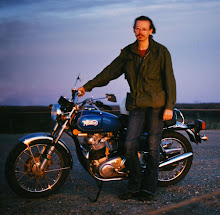
Classic image of RJ.  He enjoys flaunting his "persona" of a bad-ass motherf---r, but he has a heart of gold, a generous spirit, a first-class mind, and a heap of creative talent.

My friendship with RJ began before my first experience with ShockNet Radio, which came when Gene Rhoden asked me to be on the first episode of his show "High Instability".  I wasn't very sure I wanted to do the show, but I went ahead, and in doing so, I figured out what Gene was trying to do with his program, so I willingly became a regular participant.  This gave me more opportunities to interact with RJ and learn more about what he was trying to accomplish with ShockNet Radio.  When RJ asked me to participate in "American Heathen", I decided I'd give it a try, and things kinda went crazy from there.  I enjoyed being part of the show, a lot!  And we had our devoted followers, small in number though they were.  RJ asked me if I wanted to do a show entirely on my own, and I decided I wanted to act as DJ on a program totally devoted to blues music.

In working with RJ, it became clear that he has a very creative mind (with a healthy sense of humor), and it was both easy and fun to work with him as we began to work out the details of my vision of the show.  Since I had little or no experience of my own, I willingly deferred to RJ on most of his suggestions, but he also respected my general hopes for the program that became "Hard Luck Chuck's Juke Joint".  And as the show began, he patiently put up with my fumbling efforts to be a competent DJ, correcting my mistakes and offering me suggestions for improvements.  He's a good teacher and things began to get easier.  As the program comes to an end with the demise of ShockNet Radio, I can safely say I'm satisfied with what I was able to accomplish with my show, largely thanks to RJ's efforts.

An unexpected benefit was the people I met as a result of being associated with ShockNet Radio.  My ShockNet colleagues are some amazing people from whom I've learned a lot.  And some of our fans have become friends, despite having not yet met physically.  Although it doesn't show up in the profit/loss column, the friendships I've made through ShockNet are pretty damned valuable to me!

Many people dislike RJ for his outspoken atheism.  That's their loss, in my view.  RJ actually is not at all what his outward appearance might suggest – folks should remember not to judge the book by its cover!  He's really a very empathetic, kind person, who never misses a chance to help someone if he can.  He'd do anything for his friends if they ask.  And he's very patient with new acquaintances, regardless of their beliefs.  He really supports the American Heathen slogan of "Freedom and Liberty for ALL!". 

By what metric do you judge a person’s "success"?  And how appropriate is it for you to judge someone else's success by your choice of a measure?  I’ve known RJ long enough to see how much he's accomplished that wouldn't show up in what most people use to judge success – money, fame, and such.  His accomplishments are on a human scale, one person at a time.  Those of us who've spent enough time with him can see that.  He doesn't have many friends, but we're committed friends because we see he's a wonderful human being.  He'll be there if you need him – of that there can be no doubt.  Yes, he has little patience for certain types of foolishness – for the most part, I share those intolerances with him.  But he respects everyone's right to an opinion, no matter how silly or irrational.

ShockNet Radio was a dismal failure by the standards of those who admire the typically phony world of "big time" media.  But if you consider what ShockNet Radio has accomplished, one person at a time, as I've seen it happen, then you realize ShockNet has been a huge success.  RJ has stayed true to his vision and has touched many lives in a positive way with his efforts.  I call that a significant achievement.  And I don't give a shit what you think, if you can't see that.

Sunday, November 24, 2013

Company principles and success

A recent conversation with a friend has reminded me of something that often leaves me scratching my head in amazement.  His story concerned his transfer to a different part of the company he works for, triggered by a clash he was having with his immediate supervisor.  From his perspective (obviously, I didn't hear the other side), he was being badgered constantly for no good reason, despite his work performance being consistently good enough to earn him high performance evaluation.  He was telling me that his company (apart from his obnoxious supervisor) was very generous with holiday season bonuses and various other ways to reward their employees.  Supervisors who harass loyal and competent employees should be the ones who lose their jobs, but for reasons that escape me, they often don't.

Many years ago, I read a book - In Search of Excellence - that told of what the authors had discovered by investigating successful companies.  In a nutshell, long-term profitable companies prospered by (1) treating their customers well, and (2) treating their employees well.  This makes perfect sense, and has some significanceto current events in light of the recent push to increase the minimum wage.  Employees who are respected and rewarded when the company prospers will have a clear incentive to do what they can to help make the company successful.  If the employees are given a good reason to help the company make money, there's no reason to do anything else.  Employees treated badly find ways to pay the company back for a lack of respect.  And if the customers are given a reason to trust the company that makes products and/or provides a service, they'll continue to patronize that business, and will tell their friends about their experiences.  A dissatisfied customer may go to great lengths to get back at the business that failed to respond properly.

Yet, we find companies cutting costs by paying niggardly wages, even as company management pockets record profits.  This is precisely the wrong formula for long-term business success.  And we find companies who have an adversarial relationship with customers who buy a defective product from them.   Many businesses exhibit a blatant disregard for customer service and making good on defective products and/or inadequate or incompetent service.  How common is it these days when you have a problem with a product or service, you get into these seemingly endless conversations with robotic phone systems, to the point of complete and total frustration?  And their online customer service is equally worthless?  If you wind up speaking to a real person, that person isn't even in the USA, that service having been "outsourced" to save the business the cost of paying an American to provide such service.  Often, those foreign customer service people speak English with a nearly unintelligible foreign accent, making interacting with them frustrating and difficult.

Do businesses actually think such cost-cutting practices are helping to make them profitable?  The only way customers stick with such companies is when that business is in a near monopoly position - our way or the highway - or they have competitors that are equally thoughtless.  The only way good employees stay with such a business is when they have nowhere else to go.  The path to success in business isn't restricted to cutting costs - it's often associated with taking some of the profits and sharing them with the folks who made those profits possible:  the customers and the employees.

I can hear the right-wing pundits now.  "Sounds like socialism to me!"  Most such folks making comparisons to socialism have no clue what socialism really is.  What I'm talking about is pure free-market capitalism.  If, instead of being absurdly frugal, companies were lavish in sharing their profits with customers and employees, then they're likely to be more successful in a free market than their austere competitors.  They would have fewer clashes with unions and in many cases, their workers might even decline to be unionized because the company treats them so well.  Customers would gladly return again and again, and encourage everyone they know to patronize that business.

Much of the backlash against companies like Wal-Mart and McDonalds is driven by the disparity between their treatment of customers and employees, and the lavishly-paid managers of such businesses.  If there's any welfare associated with American business these days that's hurting this nation, it's corporate welfare for the rich.  The gap between the workers and the managers is widening and the consequences of that could easily become unpleasant.

Friday, November 22, 2013

Causes for the weather community to get behind

A never-ending story in the field of tornado hazards is the miserable construction practices that characterize so much of American frame homes.  They're mostly flimsy death traps to anyone experiencing a tornado, and it's shameful just how miserably shabby is the structural integrity of the typical American home, regardless of the price of the home.

In the course of a FEMA-sponsored survey of building performance after the 3 May 1999 tornadoes in Oklahoma and Kansas, I was made aware of not only the inadequacy of homes built to local building codes, but also the massive large frequency of building code violations in American homes.  Subsequent storm damage surveys have only served to reinforce those first perceptions.  American frame home construction is shamefully weak!

The standard building code in most of the tornado-prone areas of the USA is that the building be designed to have structural resistance to winds of up to 90 mph.  In these areas, such a code is woefully inadequate for what they might experience.  What makes this so egregious is that in hurricane-prone areas along the US coasts, the standard is much higher, and includes requirements for a number of specific enhancements to structural integrity that would be very much appropriate for tornado-prone areas, as well.  Thus, we need only modify the building codes to match those of coastal areas vulnerable to hurricanes, and we will see a much greater resistance to tornadoes.

Such enhancements would not make homes tornado-proof, but would certainly make them much more tornado-resistant.  Most of the area along even a violent tornado path experiences less than EF-3 damage, so such an increase in structural integrity obviously would reduce damage along most of a violent tornado's path.  And violent tornadoes are relatively rare.  There would be a reduction in the amount of flying debris, which would in turn reduce the damage done by tornadoes.  Of course, it's impractically expensive to retrofit existing homes to a higher building code standard, but at least we could mandate that new home construction should meet a higher standard.  In time we would see a reduction in the damage done by tornadoes.  This is not some wild dream, but is within our capabilities to afford and accomplish.

The home builders will, of course, lobby to resist such a change, arguing that it would increase their costs, which they would have to pass on to their customers.  Yes, of course, that's true - but what is the real cost of those enhancements to structural integrity?  A few thousand dollars per home - amortized over the typical 30-year mortgage, this is a really small increase in the homeowner's monthly payment.

There are other costs that homeowners might need to consider - for instance, more wind-resistant garage doors, and the installation of safe rooms.  But these are choices that individual homeowners could choose or not.  Everyone would benefit from higher standards of structural integrity over the long range.

Unfortunately, given the low probability of any particular home being hit by the violent winds of a violent tornado, it would seem that investing even that modest amount may not be an economically viable decision.  But if we have a goal of making our communities more hazardous weather-resistant, this is an essential component of that process.  I haven't worked out all the details, but the cost to our nation of this vulnerability to natural weather hazards is not inconsequential - billion dollar tornadoes are not so easy to ignore. 

Why is the weather community not backing up a call for enhancing our building codes to reflect this reality?  The American Meteorological Society, the National Center for Atmospheric Research, the National Science Foundation, etc. should be leading this effort!  Weather people need to support this with their words and with their willingness to recommend the appropriate changes to the building codes.

Another issue is the vulnerability of our children in schools.  Recently there has been some effort to get funding to have a purpose-built tornado shelter in every school in Oklahoma.  This strikes me as a bad idea, in part because many schools probably either already have an adequate shelter area or have an area that could be made adequate at relatively low cost.  Putting a purpose-built shelter in every school is probably not a good idea - it makes sense only for those schools that have no possibility of an adequate shelter.  What this requires is that knowledgeable people with appropriate expertise (structural engineers and meteorologists) should be working to do surveys of every local school to evaluate their tornado safety plans and their proposed sheltering locations.  This could be done with volunteers from state and local sources, who would contribute their time and expertise to help schools develop practical solutions to the threat from hazardous weather.  This also would be a process to enhance the weather hazard resistance of our cities and towns. 

The weather and structural engineering "communities" need to support this sort of collaboration to make the resistance of our cities and towns to hazardous weather a practical reality.  I can't speak for the engineers, but I certainly think the whole notion of helping our nation be more "weather-ready" means that our weather professionals need to step up and volunteer to make this a reality!

Thursday, November 21, 2013

A failed "slippery slope" argument

Some of my conservative friends, opposed to granting equal rights to the LGBT community, made the prediction that if we give in to homosexuals, then the pedophiles will start campaigning for similar equal rights.  Sadly, that prediction appears to have been correct.  That argument is nonsense, as I'll be attempting to show.  There's just no way to go from granting equality to LGBTs to sanctioning pedophilia.

First of all, the equality of rights to LGBTs harms no one.  They're simply being granted the same rights that heterosexuals have.  A relationship between consenting adults is no one's business but their own and is no basis for denying them the rights they have in this free nation.  There's no rational reason to declare this to be a crime.  The idea that it destroys the so-called "sanctity of marriage" is specious.  It's like saying that allowing Dr. Pepper to be served destroys the sanctity of Coca-Cola.  There's simply no way that homosexual marriage affects heterosexual marriage in any way whatsoever.  Fortunately, in the past several years, the public has finally begun to turn away from reviling and abusing LGBTs and denying them equal rights.  But is this the harbinger of descent down a "slippery slope" (something of a double entendre in this context) - a descent into a world where every criminal act is sanctioned on the basis of an argument similar to that used by LGBTs to gain equal rights?  I think not.

The key flaw in the argument by pedophiles to try to get license for their evil is that pedophilia involves children, not adults.  There's an "age of consent" clause in the legal system because children can be coerced in various ways (including but not limited to threats of violence) to do things they don't really want to do.  Even if the children seem to have granted "consent", this is a crime because they're incapable of giving such consent owing to their age.  We can argue about where the line should be drawn, but such lines are in fact drawn and are on the books.  Sexual acts forced on children below the age of consent do real harm to those children, both physical and mental.  That's why pedophilia is considered a criminal act, and justifiably so.  Pedophilia is so far from being within the confines of consenting adults, there's just no way it can be rationalized as anything other than what it is:  a despicable crime.

Similar arguments prohibit the sanctioning of incest.  There are good reasons not to sanction incest that extend to the obvious problem of inbreeding, even when involving young people over the nominal age of consent.  There's no good reason for society to ignore incest, even in such cases, owing to the powerful influence of adult family members on vulnerable youngsters, even late in their teens.  The "consent" granted is of very doubtful legitimacy.  Incest does real harm to people and so is not something to sanction.

Of course, sexual acts forced on anyone of any age are, and should always be considered violent crimes.  Thus, there can be no extension of the granting of equality to LGBTs to apply to rapists, either.  Sexual acts performed under duress (e.g., the threat of violence) are themselves acts of violence that any rational society would never condone.  Someone is harmed both physically and mentally by acts of violence; i.e., rape.  It's the absence of consent that is the key to this concept remaining a crime - it's a barrier to stop the decline along the putative "slippery slope".

Interestingly, the subject of multiple spouses came up in the predictions by my conservative friends as another part of the "slippery slope" argument.  However, I don't know if such arguments actually have been advanced yet.  Despite the general revulsion that having multiple spouses creates in many people, my perception is that if it involves only consenting adults, then I see no basic problem with it.  It's a choice I wouldn't make, but if my neighbor has two or more spouses, how does that affect me?  Not at all.  In religious cults, having multiple spouses is fairly common (so the cult leaders can have sex with all the partners they might want) - and in many cases, children are involved sexually in these relationships.  When children are involved, participants have stepped over the line.  Further, if one or more of the adults did not consent (or was forced to give "consent" under some threat), then that also steps over the line.  It's my perception that "open marriages" and "swap clubs" often wind up in bad outcomes for one or more of the individuals involved, but that's a risk that consenting adults can choose that doesn't affect me in any way.  I see no reason to define those as criminal acts.  Foolish, perhaps, but not criminal.


Monday, November 18, 2013

Another tornado outbreak - Second thoughts about chasing?

The November 17th tornado outbreak, affecting mostly some small towns in Illinois, is an example of several things.  As bad as it was, it could have been much worse - no major population centers were hit, so that particular bullet was dodged.  Despite some pitiful decisions made by the NFL about the Bears-Ravens game in Chicago, this large-venue event was not hit by a tornado.  The choice to wait to suspend the game and evacuate the field more or less at the last minute would have been a disaster if the storm had produced a violent tornado that actually hit the field.  Another bullet dodged.

There's a relentless inevitability about tornadoes, however.  Such escapes can lead people to fail to appreciate how fortunate they were, and how their luck simply can't go on forever.  Eventually, a 'worst case' scenario will happen!  The forecasters at the Storm Prediction Center did a fantastic job, anticipating this event several days in advance and ratcheting up the perceived risk as the day approached.  I hope people understand how far such forecasting has advanced during the course of my professional career, and take their forecasts seriously enough to be prepared for dangerous tornado outbreaks.

There have been some expressions of second thoughts by some thoughtful storm chasers after yesterday's events in Illinois (and elsewhere).  It seems that the events of this past May in Oklahoma, including the 31 May El Reno tornado in which 4 (or possibly 5) storm chasers were killed, have caused thoughtful storm chasers to consider how their hobby of storm chasing has a dark side:  tornadoes can cause massive human suffering that can go on for years afterward.  It's not just a show put on by the atmosphere for the benefit of storm chasers.  I've said many times that tornadoes are not evil or malevolent - rather, they're simply indifferent to their impact on humans.  When we humans are in the path, it's not by any person's design or wish, and certainly the atmosphere is not producing the carnage in any purposeful way.  (see item #32 here)

I think it's entirely appropriate for storm chasers to think over what they're doing out there - to contemplate just what they're out there for, and whether or not that reason justifies their behavior.   I hear a lot of chasers (not all, of course) going on and on about how what they do is saving lives.  I beg to disagree - that's not what you're out there to do, for the most part.  You're deluding yourself if you think so.  Virtually all storm chasers are out there because they love to see storms, myself included.  It's basically a selfish activity unlike, say, storm spotting, which is done to provide protection for communities.  If you say you're out there to save lives, prove it!  Demonstrate by your actions that your primary commitment is to save lives.  Most of the storm chasers who make such claims have done little or nothing to save lives - I've seen this with my own eyes.  In more than one case of 'chaser convergence' involving scores of chasers gathered around a storm, I learned that the call that I made to an NWS office to let them know what we were seeing was the only call from a chaser!  Irresponsible chasers of that sort are the norm, and I've watched how they behave.   What have they actually done to save lives?  Can they honestly say that's why they're out there?  I don't think so.

Irresponsible chasers certainly should take the time to reconsider their chasing!  Is a tornado outbreak just a majestic display put on by the atmosphere for their entertainment?  What price is paid by the victims so chasers can sell their video for top dollar and have their names (and faces) on the TV?  A responsible storm chaser must realize eventually that the atmosphere doesn't produce tornadoes just because chasers want to see them - chasers don't cause tornadoes, obviously.  But responsible chasers should come to understand that they need to give something back to our society that can mitigate the impact of these devastating storms.  If some chasers feel no empathy for the victims of such events, they're a poor excuse for a human being.  And they should set an example of responsible chasing rather than chasing as a trash sport.  They shouldn't be bragging about the 'extreme' risks they're taking and sneering at the notion that they should be responsible.

Tim Samaras was a responsible chaser and his loss is going to be felt for a long time - he was not about pretending to save lives.  And he didn't brag about his exploits.  Rather, he was attempting to do serious science to learn more about tornadoes, which clearly fascinated him (as they do to most chasers).  If that knowledge he was seeking could ever be used to reduce casualties, he would have been ecstatic, I'm sure.  But to be honest, that thought wasn't what drove Tim to do what he did - and there's no shame or irresponsibility to admit that's what you're doing out there.  What matters is he was doing what he could to give something back.

Saturday, November 16, 2013

Why do you atheists care about what we believe in?

The question is often posed to atheists on social media, "Why do you care about what we believe in?  Why don't you just keep your non-belief to yourself?"  There are several different ways to answer this, so I'm going to try to summarize at least some of the reasons for our being so 'militant' about what others choose to believe.

1.  Atheist commentary on religious beliefs often is triggered when believers post their beliefs on social media.  Thus, a big fraction of the commentary by atheists is driven by initiating commentary by believers.  It's a reaction to what we may see as illogical nonsense, or something contradicted by evidence, or simply bizarre.  When such commentary vanishes from the social media, so will a lot of atheist counter-commentary.

2.  We live in a time when thinking based on logic and evidence is more important than ever.  It is, in fact, dangerous when believers are so intensely driven by their religious dogma, they're willing to kill and even die in the process to further their beliefs.  It wasn't atheists who crashed planes into the World Trade Center!  Much of the existing armed conflict in the world is (and has been) associated with religious, sectarian clashing.  Many of us think that anyone who can influence the fate of our entire world should not be someone who looks forward to an afterlife of bliss.  Given the scientific issues that confront our nation - global climate change, stem cell research, genetic engineering, pollution of air and water, hazardous weather, and so on - we need more rationality, not less.  Our nation seems to be on an anti-intellectual, anti-science roll these days, which some of us see as potentially very dangerous.

3.  Many believers are "moderates", some of whom may not even support "witnessing" and proselytizing via social media, and certainly have no wish to participate in acts of fanaticism to seek the advance of their beliefs.  They often seem to be upset when atheists post something that's not a response to some religious post.  Are they similarly upset when religious believers post something that's not a response to some atheist post?  Even if they are, which seems unlikely, don't atheists have the same right to offer their thoughts about religious topics?  If you don't like our comments, just ignore them - after all, that's what you're asking us to do!

4.  Even when not responding to something a believer posted, atheists use social media to share their thoughts with other atheists, perhaps offering a new argument against religious belief, or seeking to stimulate discussion on some religious topic.  And there are a lot of doubters in the religious world - people who are beginning to question the dogma they've been indoctrinated with for years.  It can help them to feel less isolated from others to realize that others have similar questions and doubts.  Even more so for the 'closet atheists', who have arrived at atheism on their own, but fear that disclosure of their atheism will cause an overwhelmingly negative reaction from their family and friends.  If an atheist is unafraid to post commentary about religious beliefs, that commentary can be of value to those unable or unwilling to 'come out' about their atheism, allowing them to know there are others out in the world who share their doubts about religion.

5.  Religious beliefs in the USA have made considerable inroads into the way our nation is run.  Many of the laws on what defines criminal sexual behavior have their origins in the morality of religious believers.  We have 'blue laws' of various sorts that are directly attributable to the dominant christian religion in this nation.  Many politicians, even those not religious zealots, have found it beneficial to wear religion on their sleeves, and to support things like public school prayer and the slogans in our pledge of allegiance and on our currency.  The christians claim we atheists are waging war on their religious freedom - but the reality is that we simply are opposing their efforts to push their beliefs on everyone in this nation.  Being in a distinct minority means we often fail to stop the creeping theocracy we see going on.  Our only protection is the Bill of Rights in the U.S. Constitution, and many believers would like to see our nation become openly theocratic - a christian nation in the same sense that muslims now run theocracies in some nations.  We atheists don't share much other than the absence of belief in a deity, but most atheists are fearful for the loss of their constitutionally-guaranteed freedom of non-belief.  That alone justifies our 'militancy'.

I have no wish to 'convert' anyone, but I certainly would like to see a more consistent use of logic and evidence to base decisions that affect everyone.  If you don't support the use of contraceptives, then don't use them!  If you don't support abortion, then don't have one!  If you believe certain sexual acts are sins, then don't do them!  If you don't believe in evolution, then you can teach your kids your views at home, not in public school science classrooms!  If you don't believe in same-sex marrage, then don't marry someone of the same sex!  You're entitled to your opinions and beliefs - just don't expect everyone to share them and don't support laws and actions that restrict the choices of others solely on the basis of your religious beliefs.  When we have a society that unambiguously and rigidly supports the separation of church and state, then you'll be seeing a lot less atheist commentary.  Until then, get used to it!

Saturday, October 26, 2013

Driving away from tornadoes in urban areas - a bad idea

As I posted here, there have been some tornado situations of late where people have received bad advice from public and private sources regarding what to do as a tornado approaches an urban area:  that is, they have been told that if they don't have a purpose-built tornado shelter, they won't survive and should attempt to escape the tornado by driving away in their vehicles.

In the essay linked above, I give the reasons why this is a bad idea.  The notion of attempting to escape owes its existence at least in part to the now-infamous words spoken by Gary England (former weathercaster at KWTV in Oklahoma City), paraphrased as "You won't survive this tornado above ground!"  I've shown in the essay linked above that this statement, often repeated, is simply wrong, even in homes hit by EF4-5 winds in an EF4-5 tornado.  In such a tornado, the most violent winds affect only about 10% of the total damage path.  Put another way, 90% of the damage path experiences winds of EF3 or less, which means interior walls of a well-built frame home will remain standing - such is very survivable if the occupants take the recommended safety precautions (sheltering in bathrooms, under staircases, interior rooms with as many walls between you and the tornado as possible, away from windows, etc.).   What about the small fraction of homes hit by EF4-5 winds where the home is completely swept away?  Even in such unlucky circumstances, the observed fatality rate is about 1%!!  You may be injured, perhaps even seriously, but the odds of survival are overwhelmingly in your favor if you "shelter in place".  Motor vehicles can be death traps in a violent tornado.  And it's difficult to tell tornado intensity by its appearance, so you should treat all approaching tornadoes as if they could be violent - because they can be.

Recently, the National Weather Service's Central Region began an 'experiment' with Impact-Based Warnings.  I discussed my concerns about this experiment here.  One piece of fallout from this misguided experiment being perpetrated on the public is that some offices are advising the recipients of their official warnings to drive away from tornadoes.  Some private sector meteorologists are saying it's inappropriate to criticize them for doing what the NWS (or at least some offices) is doing:  telling people to flee tornadoes in their vehicles.  The problem with this viewpoint is that what the NWS chooses to do (or not do, as the case may be) is no excuse for a broadcaster to give out misinformation.  Two wrongs do not make a right.

Note:  In rural areas, it's quite possible to escape tornadoes by driving out of the path, assuming you know how to recognize which way the tornado is moving.  Also, if your home lacks adequate shelter and you're concerned about your safety, if you choose to leave for some other already-selected location where you have appropriate shelter, you should do so long before (i.e., hours)  a tornado is sighted heading your way.  Normal traffic conditions will prevail in such cases and you'll not be put in danger by waiting until a tornado actually develops and your home is in the path.

It's possible for anyone to make a mistake - giving advice for people to drive away from the El Reno and Moore tornadoes of 2013 is a big mistake.  Those broadcasting that advice need to undertand that it was a mistake, admit they made the error, and not repeat it.  There may be TV station lawyers and management who are fearful of their broadcaster's admitting to an error - for fear of litigation.  It's a very sad commentary on those lawyers and managers, if so.  Public safety should be the primary consideration in any hazardous weather event - not ratings and not the fear of litigation.  If those responsible for dispensing bad information don't willingly come forward with an admission of error and at least an apology, then it seems nothing prevents them from repeating the misinformation over and over in the future.  Doing so is a disaster waiting to happen, and it eventually will happen.

It's proven very difficult to get people to quit using highway overpasses as impromptu tornado 'shelters' despite a vigorous campaign to do so.  For reasons I can't imagine, people continue to endanger themselves (and others!) by using overpasses as tornado shelters.  Are we going to see similar persistent poor responses by the public, putting themselves and others at risk by attempting to escape tornadoes in urban areas by fleeing in their vehicles?  Only time will tell, but in the meantime, we all need to be on the 'same page' in sending out the message that this is a bad idea!

Thursday, October 17, 2013

Recognition awards

This has been my year for awards, it seems.  In June, at the European Severe Storms Conference in Helsinki, Finland, I was honored with the Nikolai Dotzek Award of the European Severe Storms Laboratory.  This is a very special and unexpected thrill for me, in part because the late Nikolai Dotzek for whom the award is named was a close friend and valued colleague. 


The "trophy" for the award is a replica of a giant hailstone (I'm holding it in the photo - with ESSL staff, left to right:  Dr. Pieter Groenemeijer - Director; Dr. Kathrin Riemann-Campe - Deputy Director; and Alois Holtzer - Treasurer), and there's a large certificate which states I received the award for "lifetime achievement in severe convective storms research".  I was flabbergasted to be selected to receive this and had uncharacteristically little to say, I was so much in shock.  Thank you so much, my European friends and colleagues!  I'm still stunned ...

A few weeks ago, I was notified that I'd been selected by the National Weather Association to receive a Special Lifetime Achievement Award for "his exceptional service and contributions to the operational forecasting and research communities through high–quality scientific research, educational workshops, and mentorship of colleagues and students". The NWA is primarily associated with operational weather forecasting (public and private), so this award has a very special significance to me - I 've always felt that the lion's share of my work was inspired by and aimed at providing help to operational weather forecasters as they deal with the most challenging task in meteorology: forecasting the weather.  Owing to the uncertainties associated with the government 'shutdown' this fall, I cancelled my trip to Charleston, SC to receive my award in person.  It appeared likely that many of my National Weather Service colleagues would be unable to attend and this award is so much for them, I couldn't justify to myself attending the conference just to have my ego stroked.  Perhaps next year, I can go to the NWA Annual Meeting and receive it then as a 'holdover'.

The outpouring ot congratulations for my awards has been overwhelming and very much appreciated.  Some years ago, I wrote a Web essay about awards and much of what I said still applies.  But this recent experience has caused me to see all this in a somewhat different light.  A number of my friends and colleagues also have been recognized by the NWA recently (Rick Smith, Bill Read, Prof. Lance Bosart, Prof. Paul Markowski, Dr. Matt Bunkers, et al.), and in their cases, they have all been very deserving of that recognition.  It truly makes me happier to see my friends receive recognition than to be recognized myself.  The work has always been my primary reward and it has never failed to justify the time and effort I've expended on behalf of advancing my profession by whatever means I possess.  It has been an honor just to have a career in science.  Whether or not I receive awards is much less important to me than the work itself.  When deserving colleagues and friends are recognized, I'm so happy to see them receive their due honors - so evidently many of my friends and colleagues have been pleased to see me get recognition for a career spent in service to the science.  Thank you so much, my friends!  I can't even begin to find words for how wonderful this makes me feel!

And I have to say that while I've been singled out for recognition, I believe no one can dispute that I've benefited from some wonderful mentors and role models, been blessed to have worked with some incredibly gifted and dedicated research colleagues, and had the support of many technical staffers who have labored mostly without recognition for their contributions to what I have managed to accomplish.  This award has my name on it, but many, many people have helped me to become a contributing scientist and so this award is also their award.  They should all know that I've  appreciated and acknowledged their many diverse contributions.  My forecaster colleagues have always truly been my inspiration - despite the difficulties and challenges that come with that job, your dedication to public service has not gone unnoticed or without gratitude for your sacrifices. 

Friday, October 11, 2013

Public tornado shelters - Not necessarily a good idea!

I understand perfectly why folks would favor public tornado shelters.  If there were public tornado shelters, then no one would have to struggle to weigh the cost of installing their own personal shelters with the low probability of ever being hit by the violent winds in a violent tornado.  The availability of public shelters completely removes that personal choice - and puts the financial burden on the whole community instead!

Public shelters have a number of issues that detract from their viability as a default solution for communities to protect themselves from the tornado hazard:

1.  When not being used to take shelter from a threatening storm, if they're wide open, then someone can use them to sell drugs, hide violent criminal activities (like rape and child molestation), or serve as a shelter for the homeless.
2.  If they're locked when not being used as a shelter, who decides when to open them and on what basis?  If the word of approaching tornado is not received soon enough, the doors would remain locked as people arrive.
3.  Are pets going to be allowed in or not?  In a case in Kansas some years back, a man was refused access because the shelter forbade pets and he refused to abandon his dog to the storm - and was later found dead.
4.  Are the shelters actually adequate for their proposed purpose?  Using public buildings, such as schools or churches, as shelters might only provide an illusion of security.
5.  How far must people go to reach their designated shelter?  If it's more than a walk of, say, 5 min, many people might want to drive to the shelter.  Is there parking enough for the capacity of the shelter?
6.  Is it really a good idea to leave a reasonably well-constructed frame home to travel to a public shelter?  Being caught in a vehicle or walking in the open can be disastrous. 
7.  Is this the best way a community can deal with the tornado hazard?  Is it the best way for a community to spend the resources ($$) it would cost to build many adequate shelters?
8.  Would every resident have access to a shelter?  Would it be acceptable to leave some segments of the population without any shelter access?

I'd like to repeat something here I've said elsewhere:  even if you have no purpose-built tornado shelter, your best choice remains sheltering 'in place' (in your home), following the guidelines of putting as many walls between you and the outside as possible, in an interior hallway, under a stair case, in a closet or bathroom (without exterior windows).  The often-repeated phrase by some media weathercasters, "You won't survive this tornado above ground!" is FALSE INFORMATION!  Even in an EF-5 tornado, by far the majority of people in the damage path will experience EF-3 or less damage.  You have a very good chance of surviving EF-3 damage in most ordinary homes.   And most people experiencing EF-4/5 damage still manage somehow to survive!  Do not become panicky and start driving away from your home, thereby contributing to gridlock and possibly being caught in your vehicle!

Public shelters make sense in mobile home parks - paid for by the park operator who would pass the costs on to the residents) provided there are enough of them to accommodate everyone needing a shelter and close enough together that people on foot can reach them quickly.   They also make sense in large venue recreational events, shopping malls, theaters, etc., assuming people know where they are, that the shelters are adequate, and people can reach them in time to be of value.  Presumably, businesses and organizations would have to come up with the cost of installing shelters if necessary, and pass on those costs to the occupants/users of those facilities.

But public shelters as a general solution for the widespread absence of tornado shelters (even here in central OK) isn't very practical.  I don't believe it makes sense for the communities to have to raise revenues to pay for shelters for all of their residents, and anything less than that would likely be unacceptable.  People need to make their own personal choices regarding whether or not to spend what it takes to install an adequate shelter for themselves and their loved ones, rather than being taxed to provide a dubious solution from the public coffers.

Although public shelters have their purposes and do have limited value, their challenges make it unlikely they can ever be a general solution for the entire populace.

Tuesday, September 17, 2013

Follow-up on the Colorado Floods

It's come to my attention that the NWS forecasts for the major flash flood event in Colorado failed to anticipate the disaster that was about to unfold.  And it seems the numerical weather prediction models did a pretty decent job in forecasting substantial precipitation in the area.  Thus, this seems to be a case where the human forecasters subtracted value from the model output, rather than adding value. Learning of this outcome is extremely discouraging to me; this kind of outcome in the face of a severe weather event is precisely what I've spent the last 30 years of my life trying to prevent with forecaster training courses based heavily on what we were trying to do in the Flash Flood Forecasting Course (FFFC).

When the NWS drops the ball by not anticipating hazardous events, the whole chain of responses to those events is threatened.  The core mission of the NWS is to protect lives and property, so by failing to anticipate damaging, life-threatening events, the NWS fails in its most basic responsibility.  Good weather forecasts make a positive difference, but poor forecasts have negative impacts.  

In my last blog, I went on at some length about the origins and content of the FFFC, which was discontinued in the late 1990s.  The original motivation was to prevent more tragedies like the Big Thompson flood of 1976.  Research studies by Bob Maddox, Charlie Chappell, Mike Fritsch, Fernando Caracena, Richard Grumm, Wes Junker, and others provided not only physical understanding of the processes by which flash flooding occurs, but also a historical perspective on the distribution and frequency of flash floods.  We learned the ingredients for a flash flood, which is truly a hydrometeorological event, involving both meteorological and hydrological aspects.  The knowledge is there, ready to be applied in operations.  "Surprises" of this sort simply should not happen.

During our 2-day lectures (as part of the 2-week FFFC), we had very little time to accomplish much in the way of advanced concepts, but the insights and instructional skill of Bob Maddox meant we packed a lot of content into that short time.  We had to do remedial education in the basics of convection, as well as training in the application of physical concepts to real-world forecasting practice.  Most of the forecasters were ill-prepared to move into more advanced topics, so we had to stick to the basics.  Even then, we were constantly challenging forecasters to re-think their understanding.  I still do these things today when I do a training course.

After the end of the FFFC, I was asked to help develop a distance learning module for COMET and the module was supposed to 'duplicate the outcome of the FFFC'.  When I asked what that outcome actually was, since I was unaware of any effort to investigate that topic in any meaningful way, I was greeted with a stony silence.  I declined the opportunity to contribute, on principle.  I didn't believe that any distance learning module could duplicate what we did in our two days.  And I still don't believe that it's possible.  Events in Colorado this year seem to confirm my opinion of distance learning.  What the NWS does for forecaster training isn't even remotely adequate and this tragedy has underscored my concerns.

In the time since our last participation in the FFFC, it's pretty likely that most of the folks we had in the FFFC are no longer sitting at operational forecast desks.  I'm deeply disappointed to learn that the 'corporate memory' within the NWS evidently no longer includes what we tried to impart during the FFFC.  In a world where NWP models are increasingly important to the forecast, it seems that at least some NWS forecasters are no longer capable of using models and the science of meteorology to produce a forecast superior to the models alone.  I've written extensively about where this trend is likely to lead us - see here and here and here and here, just for starters.  It's not something one can contemplate with much confidence that something is being done to prevent the trend from taking us where we don't want to see it go.

Those of us who spent so much time and effort trying to do something about flash flood forecasting are angry and frustrated about this massive flash flood forecast failure.  The forecasters must deal with having a 'defining moment' characterized by failure, but NWS management has to accept its responsibility for this case and do some internal soul-searching to seek a meaningful solution to the problem it represents.

Monday, September 16, 2013

Thoughts on the Colorado floods

In the late summer/fall of 1976, I had graduated with my doctorate and was working at the National Severe Storms Forecast Center (an earlier incarnation of what is now the Storm Prediction Center), in Kansas City, MO.  A colleague was on a late summer vacation in the Colorado Rockies, when on 31 July, the Big Thompson Canyon in Colorado was swept by a flash flood that killed 143 people.  My friend escaped and returned home safely, but a post-event investigation revealed it had not been well-forecast.

After the Big Thompson debacle, the National Weather Service instituted a Flash Flood Forecasting Course (FFFC) at the NWS Training Center, taught by Drs. R. A. Maddox and C. F. Chappell, who had studied the Big Thompson event, as well as many others.  Their established expertise in flash flood events made them logical instructor choices.  In the fall of 1982, I transferred from NSSFC to the Weather Research Program in Boulder, CO, with Dr. Maddox as my boss.  I was reluctant at first to get involved with the FFFC but eventually complied with his request, mainly because he was being swamped with duties.  I eventually came to embrace the course and its goals - our participation was for only 2 days out of a 2-week course, but since it focused on basic principles and application of them to forecasting, it was a great way to learn how to do effective forecaster training.  Dr. Maddox was a great instructor and, while I had to do things to match my ways, I openly copied many things I saw him doing, because they made perfect sense.  I'm still training forecasters in short courses the same way.

I learned many things about flash floods during the years spent teaching the FFFC (which eventually was discontinued), and on the occasion of the 20th Anniversary of the Big Thompson event, a symposium was held in Fort Collins, CO, that included a tour of the canyon.  The tour was a very humbling and sobering experience, and it gave me a great deal of respect for the massive power of moving water.  And added a powerful sense of urgency to my training lectures.  Since then, I continue to be troubled by our society's collective inability to grasp the significance of flash floods at a personal level.  Whereas tornadoes are relatively exotic and scary, everyone has experienced heavy rainfalls and modest flooding, so it seems that many have no respect for what moving water can do when the rainfall is sustained and the flooding becomes massive.  We've made some progress since that fateful day in 1976, but we have a way to go, yet.  Communities need to plan for high-intensity flash floods, such as what to do when roads are washed away and power is disrupted by the floods.  Regulations need to be developed and enforced to mitigate factors that serve to increase the threat, such as washed-away propane tanks.  Building on floodplains should be forbidden.  And so on.  We are not yet a 'weather ready' nation - not even close!!

One thing was clear at the 20th Anniversary Symposium:  the Big Thompson Canyon flood was not a "freak" event.  Something of the sort happens nearly every year somewhere in the high terrain of the western USA, differing only in the magnitude of the event.  People in the know have been saying for decades that Boulder, CO was long overdue for a big event ... and this year, the time had come.  Although not the same in detail as the 1976 Big Thompson flood, the ingredients were there for an event and it has come to pass with devastating effects.   As I write this, there are more than 1200 people yet unaccounted for well after the floods, and at least 5 known fatalities.

This event was foreseen decades ago - although it wasn't known precisely when and how it would happen, of course - but people this week are saying things like "We've never seen anything like this!  We had no idea things could get this bad here!"  This betrays a significant shortfall in our communication of risk to the public.  No one should be so ignorant as to believe that what they've seen in their short lives is the worst the planet can produce.  No one should be so ignorant of the illusory nature of their security when confronted by the forces of the natural world.  As I write this shortly after the 2013 CO floods, it's virtually inevitable that an event much worse than anything yet recorded in all of human history will happen someday, somewhere.  What is written in that history shows that major damaging events have happened in the past, and the lesson to be learned is they will happen again, and might well be even more devastating than anything we've experienced before!  It's not 'scare tactics' to convey an accurate risk assessment.  We owe the public an accurate understanding of the threats they might have to confront.  Evidently, we have yet to accomplish that.

Wednesday, September 11, 2013

Immigration – responsibilities

It’s a really big decision to make – to leave the nation in which you were born and move yourself (and your family) to a different country.  To move away from the culture and likely the language you were raised in surely is a choice not to be made casually.  There must be something pretty seriously negative associated with staying where you are, and the situation in the country to which you’ve chosen to move must be considerably better with respect to your reasons for leaving.

The reasons people emigrate to someplace else are often economic – they see little hope for a prosperous life for themselves and their children in their native culture, so the move is to give them the chance for a better life.  Perhaps the people are being persecuted within their own nation for their ethnicity, their politics, or their religion, so they seek the freedom to pursue their lives as they choose without persecution or discrimination. No matter what the reason, there presumably must be something pretty bad about someone’s native land and the situation in their destination country must be perceived to be better in that regard.  Otherwise, it seems difficult to understand why someone would uproot themselves to go somewhere else.  Why leave and go there if there was little prospect to a big improvement?

 It seems clear to me that when an immigrant arrives in their new land, they should be willing to live by the laws of their new nation, and to adopt their new culture as soon as possible – that is, to become assimilated into their adoptive nation as soon as possible.  This doesn’t mean they have to wipe away any traces of their native culture – but how much pride can you have for the culture and traditions of a nation that you chose to leave?

It’s often the case that immigrants gather together in enclaves of fellow immigrants from the same nation/etnicity, rather than simply dispersing throughout their new land.   This way, their neighbors speak their native language, celebrate the same holidays, follow the traditional customs, and so forth.  It’s quite natural to seek the company of others of your own kind – tribalism is built into our genes.  The problem with this clustering is that it inhibits assimilation.  The immigrants seek to retain everything familiar to them, with the exception of whatever negative situation caused them to leave their home land. 

If immigrants live by a different set of rules in their enclave from those of their new country, this is permitting at least some (and perhaps most) of what they wanted to leave behind when they left their birthplace.  Immigrants have a responsibility to assimilate, to learn the language of their new country, to follow the laws and customs of their new home even as they honor whatever good things they retain about their original culture.  Seeking to have some sort of cultural autonomy is to sanction disregard for the laws and customs of their new nation.  If they have no respect for those laws and customs, it's illogical to move from your original home to that new country?  Go back home and return to the situation you left!

And the people in the nation to which they have moved have a responsibility to not allow biases against the immigrants (perhaps including animosities many hundreds of years old) to influence how they treat the new arrivals.  It’s simply stupid bigotry to allow such “traditional” hatreds to influence how one feels about the immigrant individuals.  Why punish someone in the present for misdeeds committed by their ancestors?  Let the actual behavior of the new citizens dictate your treatment of them.  If the immigrants are working hard to assimilate, then they deserve your respect and friendship, not your hatred and contempt. If not, then you have a valid reason to be concerned about those individuals, but be sure not to judge everyone by the bad actions of a few.

Especially in the USA, we should remind ourselves of the words on a plaque inside the Statue of Liberty:

Give me your tired, your poor,
Your huddled masses yearning to breathe free,
The wretched refuse of your teeming shore.
Send these, the homeless, tempest-tost to me,
I lift my lamp beside the golden door!

Our American nation and all of its good things were built by immigrants – for all of us (including most descendants of native Americans), our heritage includes immigrants.  Let us choose to discard the bigotry we may have inherited from our unfortunate traditions.  Racism and bigotry are simply wrong and go against the laws of the USA – you have no need to despise someone else to feel good about who you are and from whence you came.  Give individuals a chance to show what they’re made of before you judge them.  Don’t consider them to be inferior solely on of the basis of race or ethnicity, and thereby unworthy of your respect as fellow citizens.

Monday, September 2, 2013

More on the EF-Scale controversy

I've already had to answer several questions regarding the EF-Scale, so I feel the need to say more on this topic.

It is true that mobile Doppler radar measurements typically are at heights well above the 'standard' anemometer height of 10 m.  In the case of hurricane recon flights, their winds are not measured at 10 m, either, but there is an 'established' procedure for converting those measurements to the standard height.  For tornadic winds, there is as yet no consensus for such a conversion.  There are some indications that in some cases, wind speeds might actually increase downward from where the radars are measuring the wind speed!  And there's little reason to believe that the winds in a tornado follow something like the conventional 'logarithmic law'.  Real tornadic winds are virtually certain to be quite complicated, with enormous changes in both space and time.  The notion of a tornado as a Rankine vortex is typically a grotesque oversimplification of what's going on.  Numerical model simulations, mobile Doppler radar observations, film/videos of tornadoes,  and laboratory vortex models have indicated that many tornadoes are much more complicated than a simple translating symmetric vortex.  Although we don't yet have the capability to map in great detail the winds in real tornadoes over the lifetime of the tornado, it's evident that the picture is mostly much more complex than any simple model can describe.

In the case of the El Reno tornado of 31 May 2013, it's my understanding that the individual subvortices within the large tornado were observed by mobile radars to be rotating at about 75 m s-1 (more than 150 mph!  If the individual intravortex flow adds only 50 mph to that, the result would be 200 mph:  the threshold windspeed for EF-5.  This information doesn't require any extrapolation to a height of 10 m.

I note that a publication exists regarding the Spencer, SD tornado of 30 May 1998 and the relationship between radar-observed winds and damage.  It's only one study, but among the conclusions was that the radar-measured winds converted to F-scale (not EF-scale!) ratings typically exceeded the actual damage at the ground.  A number of hypotheses were offered to explain the discrepancies.  Clearly, much more such work needs to be done and perhaps a consensus may emerge on how to convert Doppler-measured winds to EF-scale ratings.

Another part of the criteria for wind measurements (besides reduction to a height of 10 m) is the use of a 3-second average.  This is a standard favored by engineers for reasons they might want to chime in and explain.  But consider the aforementioned subvortex moving at 75 m s-1- such a vortex that is, say, 75 m in diameter would pass by a house in about one second.  Whatever damage such a vortex would cause to the home would be done mostly within that one second, not by a 3 s average wind!  Doppler radar wind velocities are quasi-instantaneous and extremely rapid changes in those velocities are seen even at sampling intervals of 2-s!  What meaning does the 3-s criterion have in the context of such rapid time changes in the wind speed?

After the Jarrell, TX tornado of 27 May 1997, which was rated F-5, some engineers argued that the slow movement of a large tornado magnified the damage beyond what one would expect from the winds alone - that is, winds blowing for a long time would be more damaging than winds sustained only briefly.  This seems reasonable, but what about a wind that accelerates extremely rapidly?  Could not that also enhance the damage potential?  The duration of the wind likely has some impact on the damage, but the real relationship of wind duration and damage isn't necessarily simple.  The aforementioned paper on the Spencer tornado discussed this, among other factors regarding the complex relationship between wind and damage.

Since I mentioned the diameter of a subvortex - just how does one measure the width of a tornado?  The El Reno tornado was claimed to be 2.6 miles in diameter, supposedly a record surpassing that of the tornado that hit Hallam, NE after sunset on the evening of 22 May 2004.  But how does one define the width of a tornado?  The damage doesn't have a hard edge to it, so even if you're driving at right angles to the track, how can you tell where tornado damage begins/ends?  Try it sometime.  It's not so easy as you might think!!  Debris is often centrifuged out of the tornado, so the presence of debris doesn't define the edge of the track.  Insofar as I can tell, tornado width estimates in Storm Data are probably even more inconsistent than F/EF-scale ratings.

So fast forward to a day when we can have continuous wind speed information all along the track of a tornado (not in my lifetime!) - imagine we can have a complete picture of the time-space history of the wind.  Still, where does the tornado begin and end?  Is there an arbitrary wind speed that defines a 'tornadic' wind?  How does one distinguish between winds in the rear flank downdraft (which usually is adjacent to the tornado) from the 'tornadic' winds?   One thing is for certain:  the edge of a tornado is not at the edge of the condensation funnel!  Remember - the tornado is the (invisible) wind, not the cloud. 

Given the complexity of comparing winds to damage, it seems to me that if we can obtain wind speeds from measurements, we should seek to find ways to use them, rather than to ignore them.

One final word:  there's a question about who 'owns' the EF-scale.  Who has the right to modify the rating criteria in light of new observational capability and/or new science?  At the moment, the EF-scale is something that was created by a process involving scientists and engineers, resulting in a document that forms the basis for how the scale is implemented within the National Weather Service (NWS).  But the NWS doesn't claim to 'own' the EF-scale and they should not.  No one does, at present.  It properly belongs to the whole scientific and engineering community.  Efforts are underway to establish a systematic, inclusive process for modifying the criteria as new science is available.  I can't say much about it, as it's still in the formative stages, but I sincerely hope it eventually can be recognized as the place wherein the EF-scale can become a 'living' process, rather than a set of criteria frozen into a document.  Hopefully, within such a process, many of these issues will be resolved and we can move forward to take advantage of new capabilities and new science/engineering.

Saturday, August 31, 2013

Operations versus science - the case of Storm Data

Recently, something of a brouhaha developed over the rating of tornado intensity on the so-called EF-Scale.  But there have been some important new developments.  The massive, deadly tornado on 31 May 2013 in Oklahoma initially was rated an EF-5 tornado by the Norman office of the National Weather Service (NWS), largely owing to mobile Doppler radar data, because the tornado stayed mostly in open country, with a dearth of damage indicators.

The revised F-Scale, now known as the 'enhanced' F-Scale (or EF-scale) has become entirely focused on damage indicators, so the EF-Scale has become virtually completely a damage scale, not an intensity (windspeed) scale.  This is, in part, the doing of the structural engineers, who believed the upper end windspeeds on the EF-scale were too high - they succeeding in a downward revision of the windspeeds associated with structural damage on the revised rating scale:  e.g., EF-5 now begins at a lower bound of 200 mph, whereas the F-5 threshold was 261 mph.  There are some reasons to believe this is something of a problem - i.e., rating almost exclusively on damage (with the damage indicators biased in favor of US construction practices).

In an argument evidently based mostly on the notion of consistency, NWS management is basically saying mobile Doppler data should not be used to make tornado intensity ratings.  This is the ruling that dictated downgrading the rating of the El Reno tornado from EF-5 to EF-3, as well as some others. 

The 'consistency' argument is, in my opinion, not very compelling.  This argument is unfortunately all too common within the NWS as a reaction to technological innovation. I could provide numerous examples of the wrong-headedness of this policy, but I'll try to keep this as concise as possible. Resistance to new technology, and trying to force 'consistency' with older technology is just wrong.  Should we degrade the data obtained by WSR-88D radars to that from WSR-57s simply to maintain consistency with the older data sets? Should we disregard the dual polarity information of the new upgrades to the WSR-88D radars just to maintain consistency with the old versions of the radar? When something new and exciting comes on line, its capabilities should be embraced by the agency, not rejected as inconsistent with older technology!"

Moreover, all the bureaucratic concern about the 'consistency' of the EF-Scale ratings strikes me as rather silly. The existing record is laced with numerous inconsistencies for a host of reasons - too numerous to mention in detail. Denying the value of the most direct and objective measurements of wind speed in tornadoes (apart from the extremely infrequent occasions when an anemometer record survives) in order to maintain consistency with an inconsistent data set strikes me as silly. You can argue we shouldn't introduce yet another source of inconsistency, but I say we should take advantage of new technology as soon as possible and not get trapped into this foot-dragging argument.  Actually, the Doppler data are a source that can reduce inconsistency!  I agree we need to develop a consensus on how to use the new data, but that shouldn't be an excuse to ignore the data until that consensus emerges.   At the very least, the rating of the El Reno tornado should be EF-3+, with the + sign indicating it's a lower bound based on the limited damage indicators, so the actual rating might well be higher.

The NWS bureaucracy can, of course, make up any rules they wish to impose on the process.  Their subordinates do the actual work when it comes to the 'official' record in Storm Data, and those people are subject to the dictates of their organizational managers.  However, here's the rub - much is made of the records in Storm Data, and those data form a critical part of many scientific investigations.  This is true of a lot of the data collected by the NWS - it's collected largely to serve immediate operational needs, but is the basis for a lot of scientific research, as well.  Any decisions by the agency about data collection have impacts on science.  The NWS is an agency almost totally focused on the operational application of science, not scientific research.  Although some forecasters are by their own choice, involved directly in research, their agency is not very much interested in it and offers them little or no support.  NWS decisions about Storm Data affect the science, but those decisions aren't necessarily made in the interest of science!

Friday, August 30, 2013

Photo contests - a license to steal your photos

Various and sundry photo (and/or video) contests pop up from time to time on the Web and elsewhere.  Many of them with which I'm familiar are associated with media - TV weather broadcasters, private weather companies, and such.  If you read the fine print in the agreement you sign when you submit your photos, you'll typically find something like this (an actual agreement):

By submitting your photo or media to AccuWeather for use, publication on its websites, or in its photo gallery, you hereby grant AccuWeather the perpetual, world-wide, non-exclusive, royalty-free right and license to use, reproduce, distribute and create customized versions, derivative works, and ancillaries of the photo or media in all forms of media now known or hereafter developed, including print, non-print, internet transmission, film, electronic media, advertising, and broadcasting, in all editions and in any language or technical format, for any commercial or non-commercial purpose." This effectively gives them unlimited use of your images for all time for any purpose whatsover ... let the submitter beware!!

Let's go through this carefully:

perpetual = the agreement lasts indefinitely - it never ends
world-wide = they can use your photo anywhere in the world
non-exclusive = [from here] they can resell your photo to anyone
royalty-free = they can use your photo as much as they want without paying you anything for that use
license to use, reproduce, distribute, and create customized versions, derivative works, and ancillaries of the photo = they can do whatever they want with your photo
in all forms of media now known or hereafter developed, including ... = they can use your photo in any medium existing now or in the future
for any commercial and non-commercial purpose = they can make money by using your photo 

Your photo could appear thousands of times without your express permission, thereby rendering your photo copyright effectively useless.  You may retain the copyright, but it will be of no value to you in protecting your copyright privilege.  For all intents and purposes, your photo can become "public domain" through widespread usage, rendering your copyright protection completely impotent.  You can't go after anyone for using your photo if they obtained it from the folks running your contest, and I doubt seriously that the contest folks are giving your work away for free.

The prizes in such contests are usually not all that lucrative, even for "winning" images.  Just getting your work on TV or whatever is meaningless to you if you no longer control how those photos are used. You should weigh any perceived benefit to you carefully in relation to what you're giving up just to have your photo considered.

Potential photo submitters should read the fine print associated with any such contest if they have any image good enough to win a 'prize'.  The people running such contests do not have your best interests at heart.  The image "industry" has evolved to become very unfriendly to photographers and that rapaciousness has spread far and wide.  The fact that terms like the above are widespread doesn't mean that you have to give in to them. 

Much of the same applies to video submitted to media for re-broadcast - they may pay you a modest license fee, but if you sign a license for them to broadcast your video, read the fine print and be aware of what rights you're granting. They may own it forever and have the right to use it for anything, including selling it to others ...

I strongly recommend negotiating a license only for one-time use for a specific purpose, that includes a reasonable licensing fee for you.  If they don't agree to that, don't give them license to steal your work!!  If you really don't understand the terms of a licensing agreement offered to you, don't sign anything until you search out some help in translating the legalese of the contract.  Develop your own licensing agreement and counter-offer yours to theirs.  If they won't compromise, don't let them have your work!

Wednesday, August 28, 2013

Thoughts on: MLK and "I have a dream ..."

Today (28 August) is the anniversary of the "I have a dream" speech by Martin Luther King - the day is almost over as I type this ... if there was a time in my life when I understood something important about racism in this nation, this speech touched me very deeply.  I grew up in the lily-white neighborhoods of Dupage County - west suburban Chicago.  I knew nothing of ethnic minorities - they had been systematically and intentionally excluded from my village - my communities were so predominantly white Anglo-Saxon protestant (WASP) that the very idea of a black person was an alien concept.  I literally knew no black Americans all the way through high school. It was something I knew only as an abstraction.  I grew up knowing nothing about black people except what was taught to me in classes about history.  The 1963 MLK speech (50 years ago!) was the summer of the year I graduated from high school. That he would be assassinated 5 years later was, of course, not known at the time.  His speech concerned things that meant little to me at the time because I knew nothing about black America.  Nevertheless, the speech made a lot of sense to me!

Time passed, as it always does, and I was in graduate school when he was shot and killed on that awful day.  The real impact of that on me was more than a year later, when I was drafted into the Army.  My time in the Army was a revelation, when I was thrown into the company of black Americans for the first time ever.  Angry blacks from the ghettos of America, blacks who were simply trying to cope with the shock of being in the military, and blacks who I could call my friends because of our shared experience of being thrown into the melting pot that was the military.  These people were no longer abstractions - they were real people whom I knew and interacted with on a daily basis.  Some were my friends, and some were not.  My service in Vietnam only added to the realization that blacks were not some shadowy figures in an abstract world - they were real people.  with all the foibles of real people, some good and and some bad.  Skin color was only skin deep and what really mattered was the person behind the skin ... imagine that!

Since then, I have found many Arrican-Americans that I can call friends, and those with whom I've not been able to connect.   But if there's anything that connects all of the black folks I've known over the years since my military service, it's been the realization that we're all in the same boat - hoping for a day when race is irrelevant, as Martin's speech describes.  We look forward to the day when the color of one's skin is not even remotely relevant and the character of the soul within the skin is what matters most.  I find the obvious racist paranoia of some of my conservative friends to be most disconcerting - do they not see the vile nature of their comments about black Americans?  It's a terrible legacy we've inherited to be prejudiced by something as meaningless as skin color, and one that deserves only rejection and disdain.  Make whatever judgments you must about a real person on the basis of what they have said and done, not on their enthnicity.   You attack some of those I love and respect in your misdirected hatred.  Listen to the words of one of the greatest Americans that ever walked the Earth: Martin Luther King!  Be ashamed that he met a premature fate at the hands of an ignorant bigot!  Let us come together under the benevolent banner of his dream.  Let us work together to make his dream a reality!